Zigbee ZWave Smart Sensor Protocol Integration Platform 2026
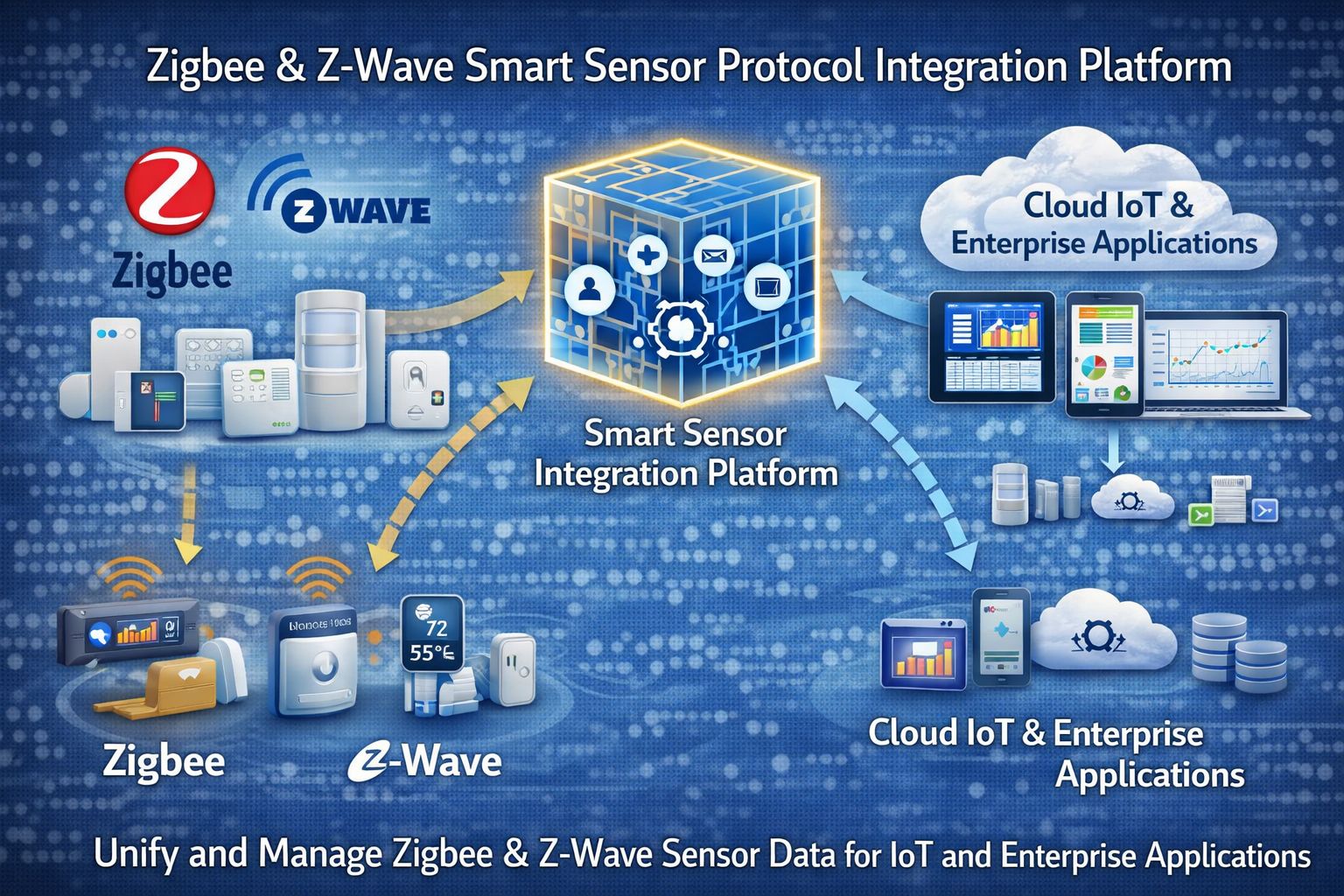
Zigbee ZWave Smart Sensor Protocol Integration Platform 2026
So in 2026, the real challenge for a Zigbee ZWave integration platform isn't about adding more devices. It's about stopping the quiet data decay that happens when two completely different mesh protocols are forced to share one data pipeline. Honestly, the failure point is usually the gateway's packet buffering when it's under load. You see Zigbee's faster, simpler frames stuck waiting behind Z-Wave's more complex, acknowledgment-heavy ones. That creates sensor telemetry delays that just break automation rules entirely.
The 2026 Integration Reality: It's a Data Pipeline, Not a Bridge
We need to forget that simple 'bridge' idea. A modern platform is more like a real-time data pipeline that's always under strain. In a live building, you're not just translating Z-Wave security frames to Zigbee clusters. You're trying to manage hundreds of concurrent state reports where, say, a Z-Wave door sensor's "closed" signal—delayed because the network is healing—arrives after a Zigbee motion sensor says the room is occupied. That one hiccup can wreck the whole sequence for occupancy-based HVAC. The real constraint isn't how many devices you have, but how many state-change events the gateway's CPU can actually line up without just losing packets.
The Silent Failure Most Teams Engineer Into Their Systems
I see this costly mistake all the time: assuming latency is uniform. Teams design workflows expecting sensor updates in 100-200ms, but they completely ignore the jitter that's baked into the protocols themselves. Zigbee, on the crowded 2.4GHz band, gets hit by Wi-Fi interference, which causes random delays. Z-Wave, on sub-GHz, is more stable but slower, and its mandatory per-hop acknowledgments add their own lag. When the platform treats both data streams as equal, critical automations—like integrating sensors into a fire alarm system—can fail in unpredictable ways because the logic engine is working with stale or out-of-order data.
When to Tune, Reconfigure, or Redesign Your Integration Layer
Here's the decision line: you can tweak polling intervals and queue sizes right up until you hit the physical limit of your gateway's processor. You can reconfigure channels and adjust mesh settings. But if your operation needs sub-second, reliable responses across mixed-protocol sensors, and every internal fix just leads to a fragile trade-off with range or battery life, then you need a redesign. That's the point where moving to a platform with a truly unified protocol engine, not just a translation layer, becomes critical. For anyone managing this, it's essential to dig into your vendor's underlying protocol mission.
FAQ
Question: What is the main problem with Zigbee and Z-Wave integration?
Answer: The core issue is the protocol mismatch messing up data flow. Their different network layers, security, and how they communicate create serialization delays and packet loss at a shared gateway. That's what breaks automations that depend on timing.
Question: Why do my sensor automations fail randomly in a mixed network?
Answer: It's usually non-deterministic latency. Your automation logic assumes data arrives in sync, but interference on Zigbee's frequency and Z-Wave's multi-hop acknowledgments make sensor update timing unpredictable. So the rules just fail.
Question: Can a better gateway solve Zigbee Z-Wave integration problems?
Answer: Only to a degree. A more powerful gateway handles more traffic, but it doesn't fix the fundamental architectural clash. Without deep integration that actually understands the timing intent of each protocol, the data streams will still be out of sync when you scale up.
Question: When should we stop trying to fix our current integration platform?
Answer: Stop when you're violating latency requirements even after hardware upgrades, or when adding more sensors makes failures spike in a non-linear way. That's a sign you've hit an architectural wall. At that stage, looking at platforms built for unified protocol execution, like snipcol, isn't just an option—it's a necessary next step.