When your sensor mesh integration starts dropping data at scale
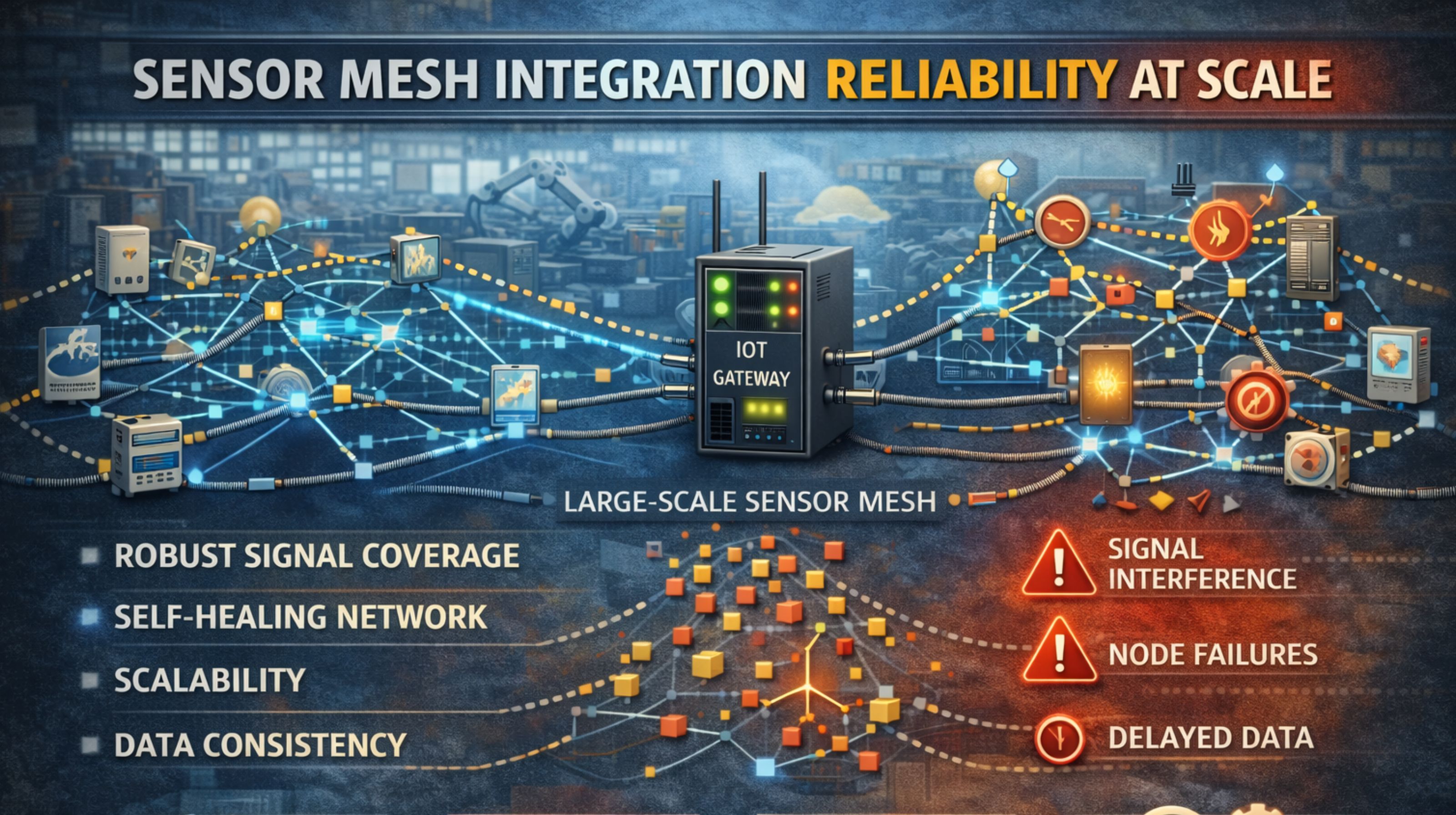
When your sensor mesh integration starts dropping data at scale
You've deployed the mesh, but the promise of seamless data flow is breaking down as you add nodes or increase polling rates; packets get lost, timestamps drift, and the dashboard shows gaps that don't reflect reality on the ground.
What reliable sensor mesh integration actually looks like in operation
A reliable mesh isn't just about connectivity—it's a system where data loss is predictable, managed, and accounted for in the application logic. It means your protocol health audit shows consistent handshake success rates even when a gateway reboots, and node discovery happens without manual intervention after a power flicker. Honestly, the real signal is in the consistency of metadata, like sequence numbers, not just the presence of a heartbeat.
The hidden load that breaks most sensor mesh deployments
Under real production load, the failure point is rarely the radio; it's almost always the translation layer and the backend ingestion pipeline. A mesh might report 99.9% link reliability, but if your middleware can't process concurrent acknowledgments or handle timestamp corrections from thousands of devices, you get silent data corruption. One non-obvious detail that gets missed is the buffer management on the gateway—when it's overwhelmed, it doesn't always fail noisily. More often, it just starts sending stale data as if it were current, which creates a deceptively false sense of operation.
Assuming your mesh protocol handles its own error recovery
A common and costly misunderstanding is treating the mesh network layer as a fully reliable transport. Most industrial protocols do have retry logic, but they assume stable physical layers and predictable latency. In a dense, dynamic mesh, collisions and path changes can cause retry storms that saturate the network, a scenario the protocol spec never really anticipated. Teams then waste months tuning radio parameters when the real issue is often an application layer that isn't idempotent, re-requesting data the gateway already queued.
Deciding how much integration depth your mesh actually needs
The decision isn't just between shallow or deep integration—it's about identifying which failures your specific business logic can actually tolerate. Can you operate if temperature readings are 10 seconds late? Probably. Can you if safety device status is ambiguous? Absolutely not. You should start by instrumenting the data flow at the protocol engine node to measure latency distribution and acknowledgment loss patterns. That data tells you whether you need to invest in stateful session management or if simple, fire-and-forget messaging with redundancy is sufficient. The real boundary is real-time control; if your mesh feeds a closed-loop control system, shallow integration will almost certainly fail.
FAQ
How do you measure sensor mesh reliability before scaling?
You measure it by injecting controlled faults—simulate gateway failover, packet loss, and clock skew—and watching not just if data arrives, but if the meaning of the data (order, timing, context) is preserved at the application endpoint.
What is the biggest risk when integrating a new mesh into an old SCADA system?
The biggest risk is data model mismatch. The SCADA expects polled, synchronous data, but the mesh provides asynchronous, event-driven bursts. This can overwhelm the legacy poll cycle and cause the SCADA to ignore valid data as noise, creating critical blind spots.
Can a sensor mesh handle real-time control for safety systems?
Rarely, and not without dedicated, deterministic sub-networks and deep integration that treats latency as a hard constraint. For true safety-rated control, meshes are typically limited to monitoring, with hardwired or star-topology networks handling the control loops.
When should we consider a universal protocol bridge over custom integration?
Consider it when you have multiple mesh types or need to merge mesh data with other industrial streams for unified IT/OT dashboards. Custom code becomes unmanageable at this point, and a bridge handles the continuous protocol health checks and data normalization that in-house teams often deprioritize.