When Your Integration Scale Limit Triggers a Sudden Performance Drop
When Your Integration Scale Limit Triggers a Sudden Performance Drop
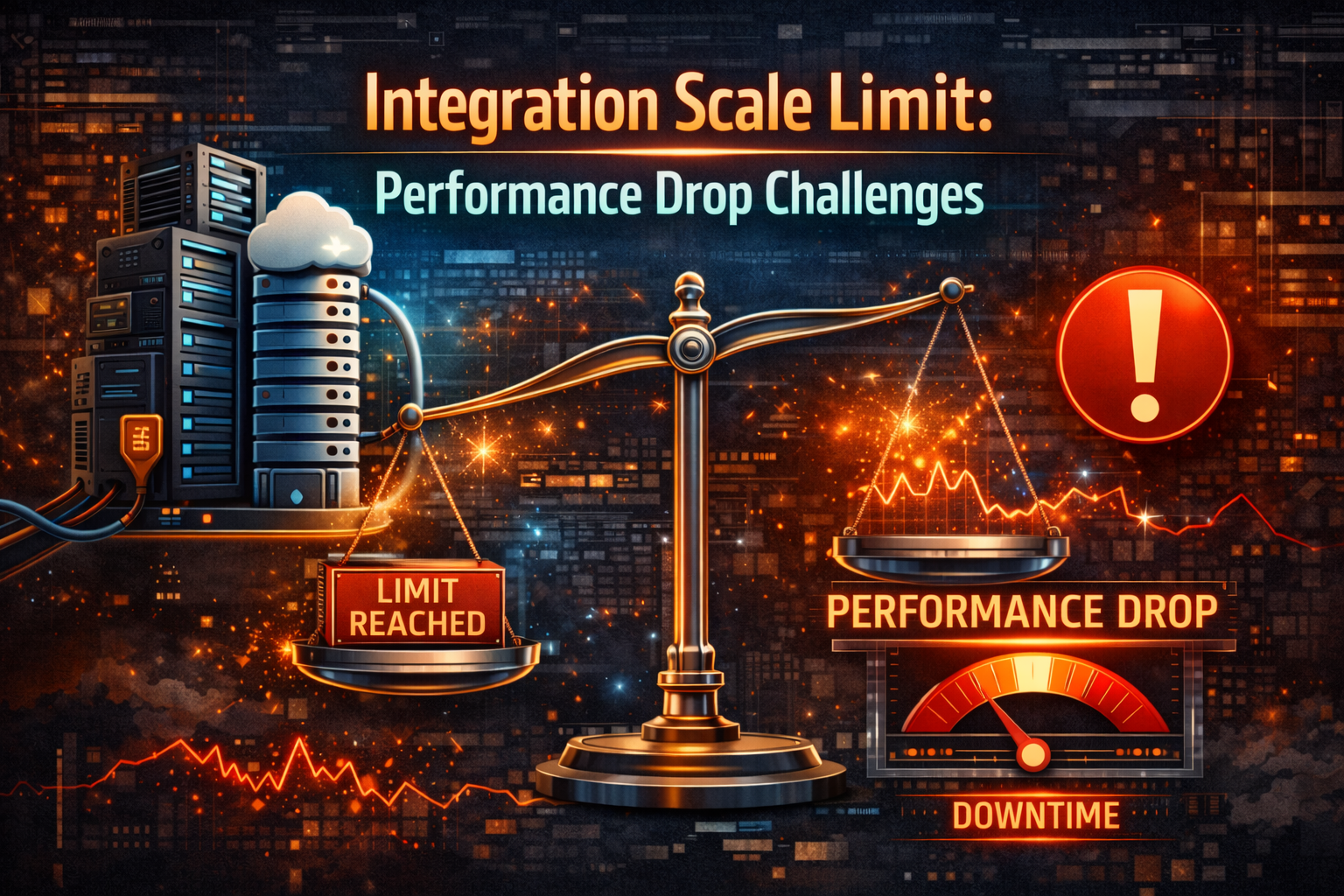
You add more devices, more data points, expecting linear scaling. But then the system hits a hard wall—latency spikes, timeouts start cascading, and critical processes just stall. It's not a gradual slowdown. It's a cliff-edge failure, and it happens when you finally push past the underlying protocol or architectural limits under real load.
What "Scale Limit" Means for Real-World Industrial Systems
In practice, a scale limit isn't just some number on a datasheet. It's the point where your protocol's handshake mechanism, or its polling cycle, or the network broadcast traffic, can't keep up with the transaction volume anymore. Take a BACnet MS/TP network: it might handle 30 devices smoothly, but that 31st device? It can cause token-passing delays that make the whole segment unreliable. The limit is always defined by the slowest, most constrained layer you've got in the stack.
The Reality Under Load: More Data, Less Reliability
So what actually happens when you push past, say, 80% of a stated limit? Message queues fill up faster than they can be cleared. Heartbeat packets get dropped, so devices look offline, which triggers automatic reset cycles... and that just adds more traffic. I saw this once in a live building: exceeding the recommended device count on a Modbus RTU segment caused the master controller to miss critical alarm packets from fire panels for a full 12 seconds. A dangerous failure that average performance metrics completely hid.
Common Mistakes That Accelerate the Performance Cliff
The costliest assumption is that "headroom" is safe to use. If a gateway is rated for 10,000 points, teams will plan for 9,500. But that rating assumes ideal, evenly distributed traffic. Real-world traffic is bursty. A simultaneous alarm condition from hundreds of points can create a spike that just overwhelms the gateway's CPU, causing a total comms freeze. Another classic error is mixing high-frequency data—like sensor readings—with low-frequency but critical commands, like valve closures, on the same channel without proper QoS. You're practically guaranteeing the important commands get lost in the noise.
How to Decide Your Next Move Before the System Fails
Your decision really hinges on diagnosing the true bottleneck. Is it the protocol's inherent speed? The controller's processing power? The network's physical layer? You need to start by analyzing traffic patterns during peak operational loads, not during commissioning. The goal is to find that "first failing component." Sometimes, the right fix isn't a bigger gateway, but segmenting the network or adding a buffering and prioritization layer, like a protocol engine. For teams figuring this out, specialized integration support can be crucial to map the failure points before they cause real downtime.
FAQ
Question: How do I know if my system is near its scale limit?
Answer: Watch for non-linear latency increases. If adding 10% more devices causes a 50% jump in response times, or you see a sharp rise in packet retries, you're probably operating in that degraded zone right before the total drop-off.
Question: What's the biggest risk when performance starts to drop?
Answer: It's the cascade failure. A slowdown in one subsystem can make upstream systems time out, which then triggers their own error-recovery routines. Those routines generate even more network traffic, and it can end up taking down services that seemed completely unrelated.
Question: Can upgrading hardware alone solve a scale limit problem?
Answer: Not always. If the bottleneck is something like a serial protocol's baud rate or a fieldbus's token rotation time, a more powerful controller will just sit there idle, waiting for the network. You have to address the actual slowest layer in the chain.
Question: How should we scope the fix for a scaling failure?
Answer: Scope it based on the failure mode, not just the symptom. If timeouts are the issue, you need to implement something like a protocol health audit to tell network congestion apart from device processing delays. The fix might be architectural—like adding a dedicated data concentrator—rather than just swapping out hardware.