When Legacy Protocol Conversion Latency Causes System Failure
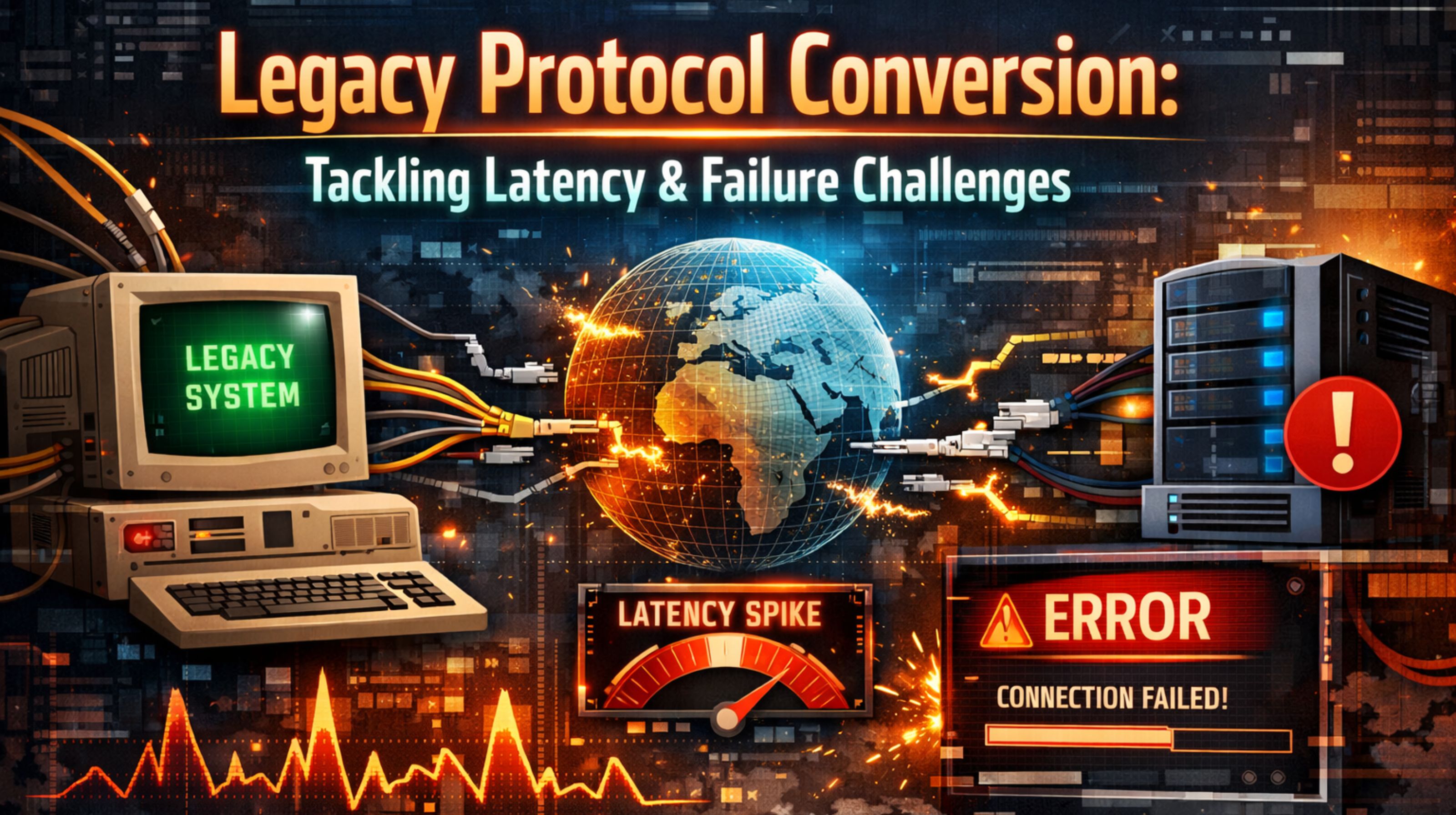
When Legacy Protocol Conversion Latency Causes System Failure
Look, you're not just adding a gateway here. You're actually inserting a critical failure point, where even milliseconds of delay can cascade into a full operational shutdown or a complete data blackout.
What Conversion Latency Means for Real-Time Control
In practice, conversion latency isn't just a single number. It's this variable gap that completely disrupts closed-loop control. You end up with actuators responding to stale sensor data, and that's what leads directly to process instability.
The Reality Under Load: Where Bottlenecks Actually Form
During peak operations, the conversion layer often gets saturated. And it's usually not from the raw data volume. It's from the overhead—the stateful session management and error-correction routines that the legacy protocols were never designed to handle. That's what creates those unpredictable lag spikes.
Common Mistakes That Guarantee Timeout Failures
A major misunderstanding is assuming a simple protocol translator is enough. Teams often miss the need for proper buffering strategies and health monitoring for the conversion process itself. That thing silently degrades until, finally, a critical command just times out. For a deeper technical review, a protocol health audit can uncover these hidden risks.
How to Decide: Bridge, Replace, or Isolate the Legacy Layer
The decision really hinges on the system's tolerance for jitter. If your control loops are tight, a direct hardware replacement might actually be cheaper than dealing with the ongoing risk. On the other hand, for non-critical monitoring, you might get away with a buffered bridge approach.
FAQ
Question: How much latency is too much for Modbus RTU to TCP conversion?
Answer: Honestly, it depends entirely on the control cycle. For a fast loop under 100ms, even 20ms of inconsistent jitter can cause oscillations. For slower supervisory systems, maybe 500ms is acceptable... until a network blip causes a timeout anyway.
Question: What's the hidden risk when conversion seems to work in testing?
Answer: The biggest hidden risk is cumulative buffer exhaustion. During testing, data flows are clean. In production, you get retries, malformed packets, and network collisions. That stuff fills the buffers, causing conversion drops or massive latency spikes that only show up under sustained load.
Question: Can adding more powerful gateway hardware solve latency issues?
Answer: Not always. The bottleneck is often the legacy protocol's own polling mechanism or the serial line speed itself. Throwing hardware at a software or architecture limitation just moves the point of failure. It can even make timeouts harder to diagnose.
Question: When should we abandon conversion and do a full protocol upgrade?
Answer: The tipping point is when the cost of managing conversion failures—the downtime, the engineering hours, the safety risks—exceeds the capital project cost for new endpoints. If latency is causing regular process upsets or data loss, then conversion is just a band-aid, not a real solution. For strategic planning on these integrations, exploring a universal protocol service can sometimes provide a clearer path forward.