When Communication Loss Forces an Operational Shutdown
When Communication Loss Forces an Operational Shutdown
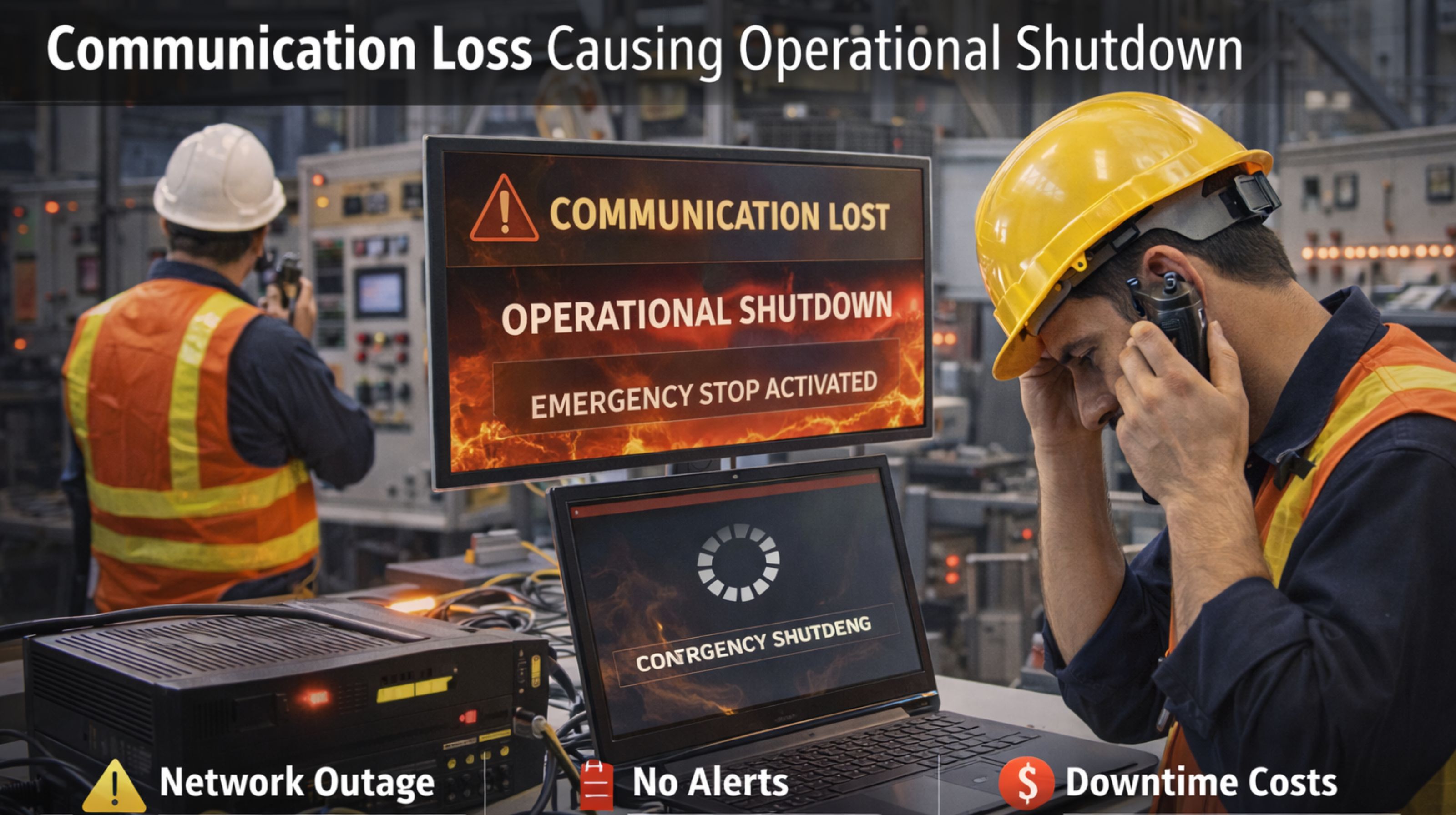
A silent sensor or a frozen control loop isn't just data loss—it's a direct path to a hard stop. In production, safety, or building services, that's the moment protocol failure becomes a physical system halt.
What Communication Loss Means for a Running System
In practice, communication loss is a loss of state, not just an error code. A PLC waiting for a sensor heartbeat will often default to a safe state, which usually means shutting down a line. And a building management system that loses its HVAC controllers? It'll freeze setpoints, which can trigger a cascade of comfort alarms and manual overrides that stop all the automated routines. The immediate consequence is almost never just "missing data." It's a predefined fail-safe that stops operation.
The Reality Under Load: Cascades and Hidden Dependencies
What the engineering diagrams never show is the cascade. A single Modbus TCP timeout on a critical power meter might be designed to just alarm. But under peak load, that alarm can flood a legacy SCADA historian and cause it to lag. Then operators miss the next alarms from other systems—fire panels, pump VFDs—creating a blind spot that delays everything and extends the shutdown. Honestly, the real failure is often in those secondary systems that weren't built to handle the primary failure.
Common Mistakes That Turn a Glitch Into a Full Stop
The biggest risk is assuming your fail-safe logic is good enough. Teams set watchdog timers or heartbeat intervals, but they don't test the full chain under degraded network conditions. There's also a common misunderstanding that a redundant network path eliminates shutdown risk. But if the protocol session itself—like a BACnet or OPC UA connection—times out during the failover, the application layer may still initiate a shutdown. Another critical miss? Not defining the boundary condition. At what point of intermittent loss does the system decide to halt versus retry? Without that, systems can just flap between states and cause repeated shutdowns.
Deciding Your Response: Patch, Redesign, or Accept the Risk
When you're facing recurring shutdowns, the decision isn't purely technical. You have to figure out if it's a protocol instability, a network infrastructure flaw, or just an overly aggressive safety interlock. Start by auditing the actual failure messages and timestamps—often, the root cause is something simple like a mismatched timeout value between devices. For deeper protocol issues, a service like Snipcol's Protocol Health Audit can map the conversation failures. In the end, the choice is pretty binary: implement some buffering or damping logic to prevent spurious trips, or accept that certain losses must trigger a shutdown for safety, and then harden the communication path to match.
FAQ
Question: What usually causes communication loss in industrial networks?
Answer: The root cause is rarely a single cable break. It's usually a combination of things—a switch misconfiguration (like spanning-tree blocks), a serial gateway getting overloaded, or protocol stack timeouts that don't match between master and slave devices. That mismatch is what leads to session drops.
Question: How can we prevent a full shutdown from a temporary glitch?
Answer: Implement application-layer damping. Use a "loss counter" that requires multiple consecutive missed messages before triggering a shutdown. Pair it with a buffered last-known-good-value to keep processes running through brief interruptions.
Question: Does adding more network redundancy eliminate shutdown risk?
Answer: Not completely. Network redundancy protects the physical layer, sure. But if your control protocol—say, PROFINET or EtherNet/IP—has a session timeout of 2 seconds and the network reconvergence takes 3, the control system will still see a loss and may shut down. You have to align the protocol resilience with the network resilience.
Question: When should we redesign a system instead of patching timeouts?
Answer: Redesign becomes necessary when the shutdown risk comes from a fundamental architectural flaw. Think a single point of failure in a serial-to-Ethernet converter, or using a legacy protocol that can't support the heartbeat rates you need. The decision point is when the patchwork starts creating an unacceptable level of operational complexity.