Weighbridge Loadcell Sensor Data Integration with ERP Software
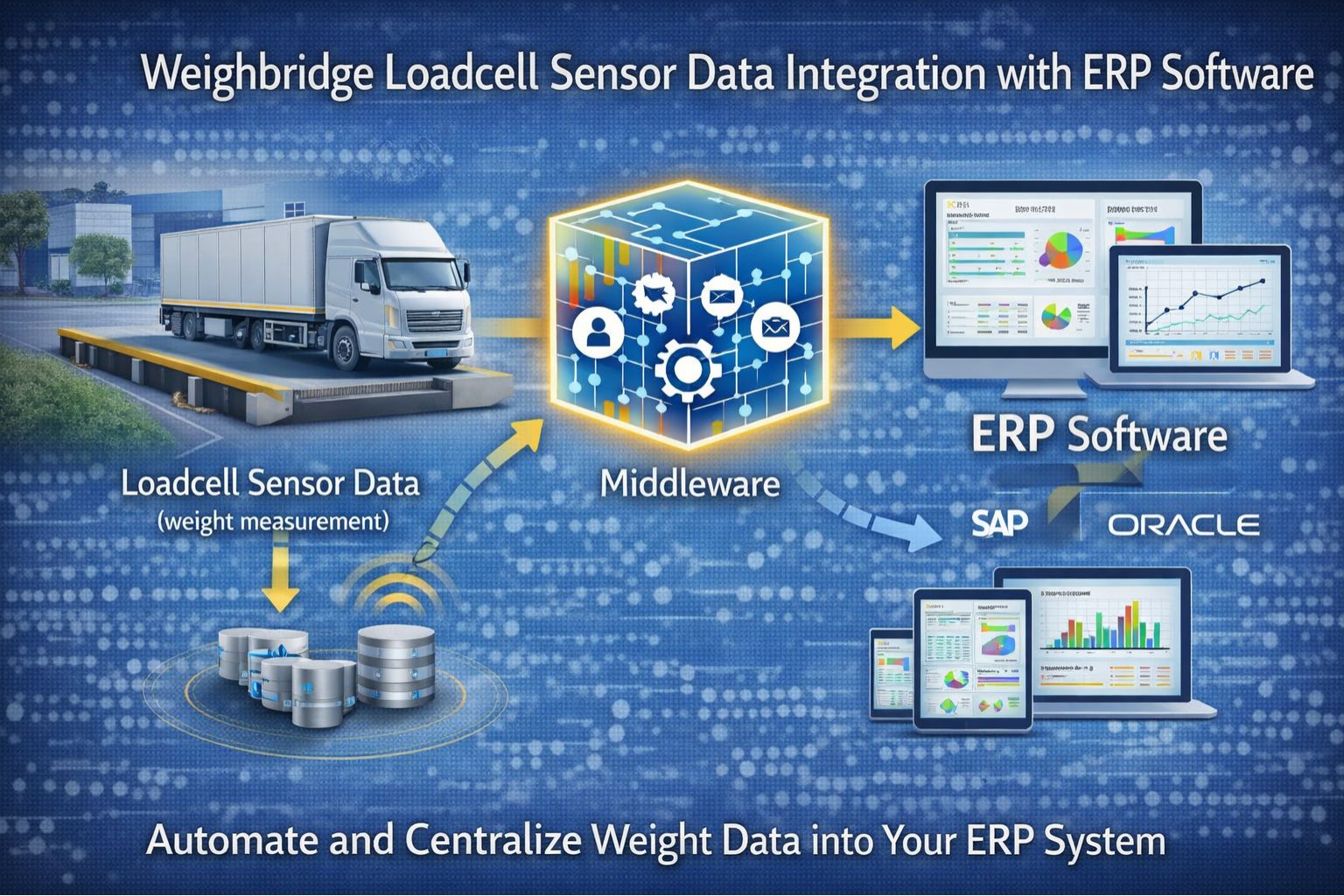
Weighbridge Loadcell Sensor Data Integration with ERP Software
When weighbridge loadcell sensor data fails to integrate cleanly with ERP software, the disconnect isn't just a data sync error—it's a direct hit to inventory accuracy, financial reconciliation, and operational trust. The real problem is that loadcells output a continuous, time-sensitive data stream, while ERP systems expect discrete, validated transactions. The industrial protocols bridging them often introduce fatal delays or data corruption, and internal IT teams usually can't see it until a truck gets weighed wrong.
The Real Meaning of Loadcell-to-ERP Integration Failure
In real IT/OT integration environments, a failed integration means the weight captured at the physical scale never becomes a verified goods receipt or dispatch note in the ERP. This isn't about a slow report. It's about a sensor polling cycle missing a truck's entire weigh-in because the Modbus TCP buffer filled up, or an OPC UA session timing out before the weight stabilized. That leaves the ERP with a null value that someone has to manually override, which just erodes the entire system's data integrity.
What Happens at Live Industrial Scale
Under live industrial scale, with trucks queueing, the system doesn't fail gracefully. Sensor data packets get buffered at the IoT gateway during network congestion, which causes time-stamp mismatches. The ERP, expecting sequential weight-in and weight-out transactions, then receives data out of order. That leads directly to negative inventory or incorrect invoicing. Teams often ignore the gateway's internal clock drift against the ERP server—a non-obvious detail that accumulates discrepancies throughout the day. It turns reconciliation into a nightly forensic exercise instead of a real-time process.
Common Mistakes and Hidden Risks
A major failure pattern is assuming the loadcell's digital converter output is just compatible with the ERP's middleware. Many teams configure for a continuous data push, which overwhelms the ERP's ingestion layer, or they batch weights and lose real-time validation. The common misunderstanding is treating sensor data like database entries. They ignore that a loadcell value is only valid at the moment of stable weight. Any latency in transmission or protocol translation turns an accurate physical measurement into unreliable business data, which is a critical flaw in IT/OT integration.
When to Tune, Reconfigure, or Redesign
The decision boundary is usually clear: you can tune polling rates and timeouts if discrepancies are minor and predictable. You have to reconfigure the protocol bridge and data schema if weights are missing or mismatched under load. But internal fixes stop working when the fundamental architecture—like a direct serial-to-ERP path—just can't handle the validation, sequencing, and error-correction required for audit-compliant weighing. At that point, you need a redesign with a dedicated industrial edge processor that handles protocol translation, data validation, and transactional handoff to the ERP. That's the boundary where snipcol contextual solutions often become necessary to prevent financial and compliance exposure.
FAQ
Question: Why does my weighbridge data show the correct weight on the local display but wrong values in the ERP?
Answer: This is typically a protocol translation or data mapping error. The local display reads the raw loadcell signal directly, but the data sent to the ERP passes through a gateway. That gateway might be applying incorrect scaling or unit conversion, or it could be suffering from packet loss in the industrial network, which corrupts the value before it ever reaches the software.
Question: How does network latency affect loadcell ERP integration?
Answer: Latency introduces a critical delay between the physical weighing event and the ERP transaction. If the weight is captured during a truck's brief stop, high latency can mean the "stable weight" signal arrives at the ERP after the truck has already left. That causes the system to either record no weight or use an unstable, inaccurate reading, which completely breaks the inventory workflow.
Question: What's the biggest risk of using batch uploads for weighbridge data?
Answer: The biggest risk is losing transactional integrity and time-series context. Batch uploads disconnect the weight from its specific moment and vehicle. That makes it impossible to automatically match weight-in and weight-out for the same truck. You end up with manual reconciliation errors, inventory shrinkage, and no way to trace discrepancies back to a specific weighing event.
Answer: You need a redesign when tuning and reconfiguration fail to maintain data integrity under normal operational load—basically, when weights are consistently missing, mismatched, or require daily manual correction. That's a clear sign the architecture can't handle the real-time, validated transaction flow required. It necessitates an edge processing layer to manage reliable protocol translation and handoff.