SCADA Integration Failure During Site Acceptance: Root Cause Analysis
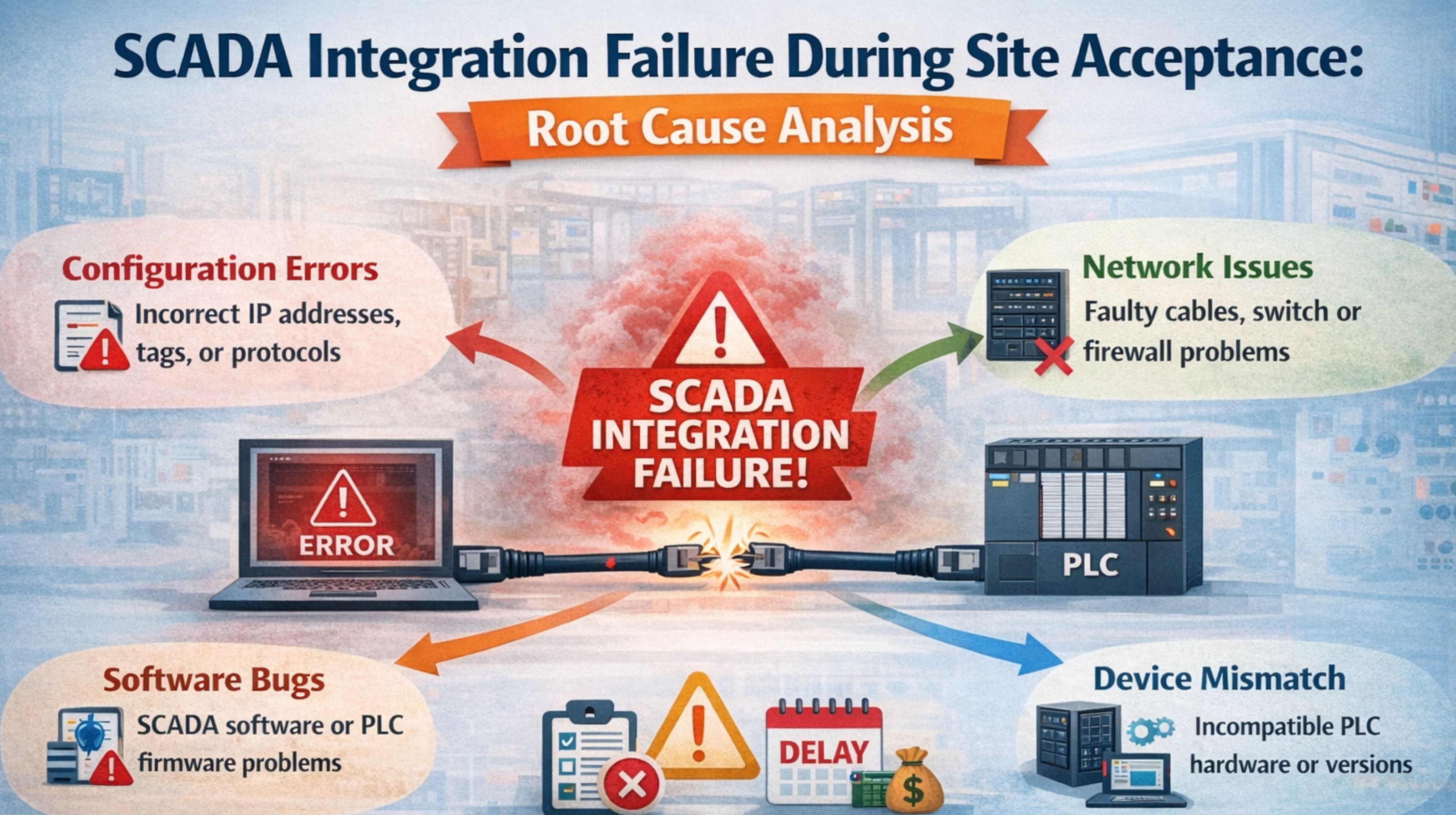
SCADA Integration Failure During Site Acceptance: Root Cause Analysis
When your SCADA system fails to talk to field devices during that final site acceptance test, you'll see a protocol timeout or a malformed packet. That's just the symptom, though. The real problem is usually a deeper mismatch—between how the integration was designed and how the plant floor actually runs. That mismatch puts your commissioning deadline, your operational certificate, and frankly, the whole project's budget on the line right then and there.
Clarity: The Failure Is Architectural, Not Just a Bad Cable
What you see—OPC UA disconnects, Modbus timeouts, historian gaps—is just the surface. The root is often an uncoordinated protocol stack. The middleware, gateways, and drivers just weren't built to handle the real concurrent load, the bursty traffic, or the security handshakes of a live network. It creates a fragile, point-to-point setup that falls apart the moment you do a proper system test.
Reality Check: What Happens Under Commissioning Pressure
During site acceptance, you power everything on at once. The burst of initialization traffic, plus security scans and historian backfilling, can overwhelm the buffers and session limits in older gateway stacks or lightweight API middleware. It doesn't degrade gracefully; it breaks completely. That triggers an alarm cascade, stops functional testing dead, and risks blowing the entire project timeline, with potential SLA penalties on top.
Mistake Risk: Where Protocol Tuning Stops Working
The most common mistake is trying to fix this by tweaking protocols—adjusting timeouts, retry counts, scan rates. That usually fails because the core issue isn't a single parameter. It's the lack of a coordinated data plane. When Modbus, OPC UA, and MQTT streams all fight for the same transport layer without any priority, tuning one just moves the failure to another. You end up in endless debug cycles, delaying commissioning even more.
Decision Help: Patch, Redesign, or Replace the Architecture
So you're stuck with a critical choice: keep patching individual drivers and hope for stability, attempt a risky mid-project architectural redesign, or look at a replacement system built for multi-protocol coordination from the start. The right call depends on how bad the instability is, how close your final audit is, and the hidden cost of constant rework. A systematic protocol audit is really the necessary first step to figure out where the failure boundaries actually are.
FAQ
Question: Is this usually a problem with the PLC or RTU configuration?
Answer: Rarely. The field devices usually pass their own Factory Acceptance Test. The failure shows up at the integration layer, where data from all these different protocols and vendors has to be normalized, sequenced, and delivered reliably to the SCADA HMI and historian—especially under real load.
Question: What's the biggest operational risk if we just extend the testing window?
Answer: The risk is that the instability is baked into the system's architecture. Extending testing without fixing that just burns time and money. The underlying fragility remains, which pretty much guarantees future unplanned downtime, failed audits, and expensive emergency support calls after handover.
Question: At what point does adding more gateway hardware fail to solve the problem?
Answer: When the problem shifts from bandwidth to coordination. Adding more gateways just gives you more points of failure and complexity if there's no unified logic layer to manage state, failover, and data consistency across all those protocol connections. That's a challenge some teams address with a snipcol to handle the multi-source integration logic.
Question: When should we consider a full architecture replacement versus a patch?
Answer: Seriously consider replacement when the combined cost of delays, rework, and future instability risk outweighs the cost of a new system. If the failures involve multiple protocols, are reproducible under load, and are blocking critical handover milestones, then patching is just a temporary fix. It piles up technical debt and leaves you exposed for future audits.