Real-Time Sync Across Distributed Sensors
Real-Time Sync Across Distributed Sensors
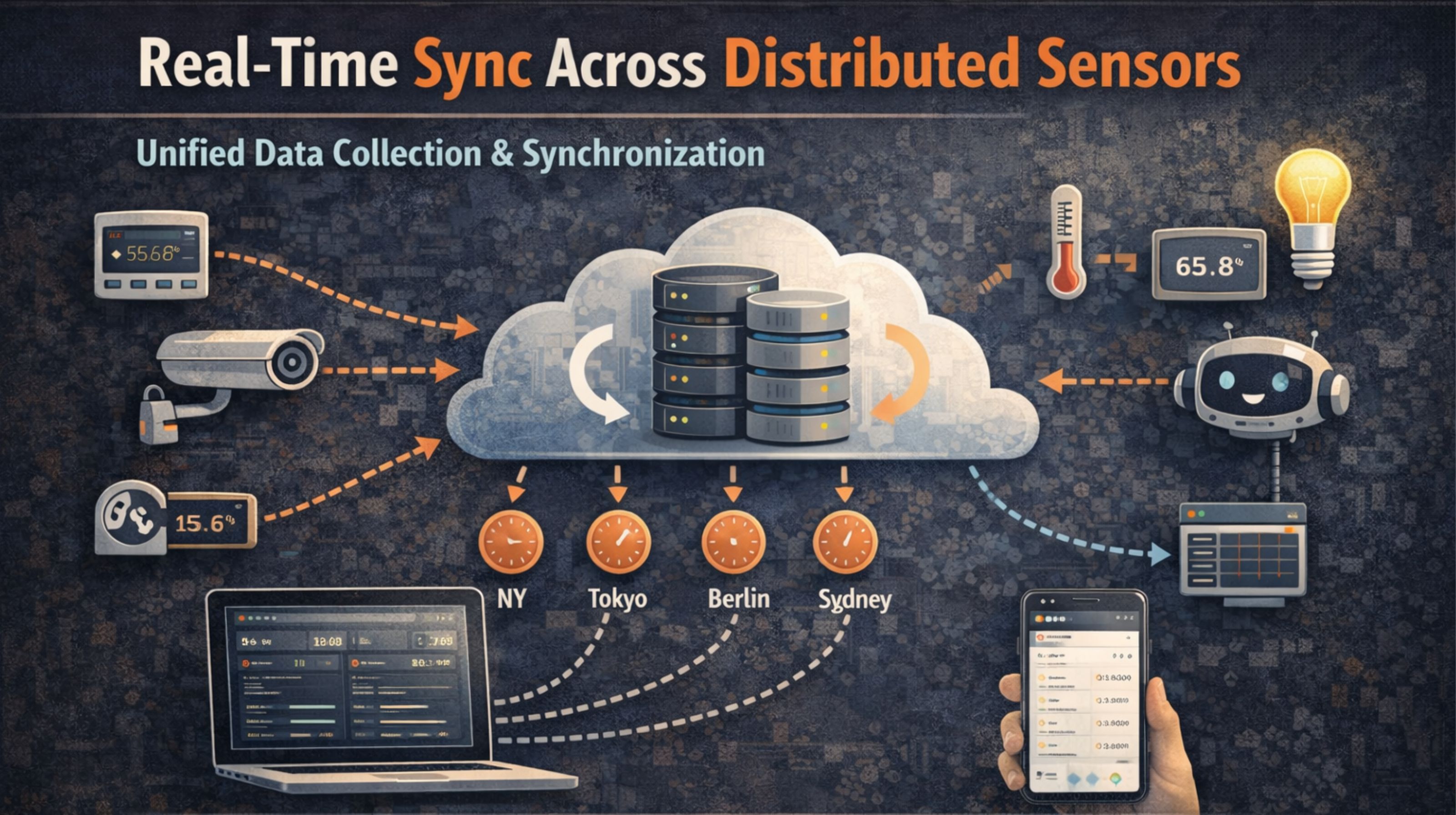
Getting real-time sync right across a bunch of scattered sensors is pretty much the backbone of modern data systems. It's all about making sure data collected from devices in different locations is coherent and happens at the same time. That's what lets us analyze and react instantly in fast-changing situations. The tricky part, technically, is dealing with things like lag, clocks that slowly fall out of step, and spotty network connections. Nailing this sync is absolutely fundamental for everything from the Internet of Things to running automated factories.
Core Challenges of Distributed Sensor Synchronization
There are a few big technical headaches that make real-time sensor sync so difficult. For one, network latency isn't consistent—it can vary, which skews data between different nodes. Then there's clock drift: each sensor's internal hardware clock ticks at a slightly different speed, so their timestamps become less and less accurate over time. Add in packet loss and intermittent dropouts, and you've got a recipe for disrupted data streams. Any sync protocol has to tackle these issues head-on to create a single, unified timeline. And of course, the whole system needs to scale up efficiently as you add more and more sensors.
Key Protocols and Technologies for Synchronization
Luckily, we've developed some specific protocols to meet these sync needs. The Precision Time Protocol is a real cornerstone, giving you sub-microsecond accuracy in networked setups. For broader internet sync, there's the Network Time Protocol, though it's not quite as precise. On the wireless side, protocols like Bluetooth Low Energy and Zigbee have their own sync mechanisms built for mesh networks. Often, edge computing gateways will do some pre-processing to align timestamps before sending data to the cloud. And in many cases, a hybrid approach that combines a few different technologies ends up being the most robust.
Architectural Patterns for Real-Time Data Coherence
How you design the system architecture has a huge impact on whether sync works. One common model uses a centralized time server as a single source of truth for all the sensors. Alternatively, a peer-to-peer approach lets sensors sync directly with their neighbors in a mesh. For really large-scale deployments, a hierarchical architecture with tiered levels of synchronization often works best. There's also the event-sourcing pattern, where every sensor reading is treated as an immutable event with a carefully coordinated timestamp. Which pattern you choose really comes down to your scale, how precise you need to be, and your network's layout.
Applications and Industry Use Cases
When you get real-time sensor sync working, it unlocks some pretty transformative applications. Managing a smart grid, for instance, depends on perfectly synchronized phasor measurement units to keep everything stable. Fleets of autonomous vehicles need ultra-precise sync so they can collaboratively perceive their environment and plan routes. In industrial IoT, predictive maintenance correlates vibration and temperature data from multiple points on a machine. And in scientific research—think radio telescope arrays—you might need nanosecond alignment for accurate observations. These kinds of use cases are what keep pushing sync technology forward.
FAQ
What is the primary goal of real-time sensor synchronization?
Basically, it's to create one coherent timeline for events captured across a bunch of separate devices. That way, systems can accurately figure out how events relate to each other and understand what caused what.
Why is clock drift a major problem for sensors?
Clock drift happens because every sensor's internal oscillator runs at a slightly different speed. Those tiny differences add up over time, making timestamps drift apart. If you don't correct for it, correlating the data becomes impossible.
How does PTP achieve higher precision than NTP?
The Precision Time Protocol uses hardware timestamping right at the network interface and measures path delay in both directions. This cuts out a lot of the variability from the software stack and network queues that messes with NTP's accuracy.
Can synchronization work in offline or disconnected environments?
It can, but not in real-time. You use post-hoc synchronization algorithms instead. Sensors record data using their own local clocks, and later on, algorithms align the data streams by looking for shared events or markers.
What role does edge computing play in synchronization?
Edge gateways often act as local sync hubs. They gather data from nearby sensors, line up the timestamps, and do some initial processing before sending neat, coherent batches to the cloud. This saves bandwidth and takes some load off the central system.
Is wireless synchronization less accurate than wired?
Usually, yes. Wireless connections just have more variable latency and interference. That said, modern wireless protocols—like IEEE 802.15.4 with TSCH—are specifically designed to provide really reliable, synchronized communication schedules.
What is a "grandmaster" clock in synchronization architecture?
That's the main reference time source for the whole network, like a clock getting its time from a GPS signal. Every other device in the sync hierarchy ultimately gets its accurate time from this one source.
How do you test the accuracy of a synchronized sensor network?
One way is to create a single physical event that multiple sensors can detect at the same time, and then check how much their timestamps vary. You can also use special test equipment to send precise timing packets through the network to measure path delay and see how well the corrections are working.