Real-Time Connectivity Mismatch Errors That Block Your Deployment
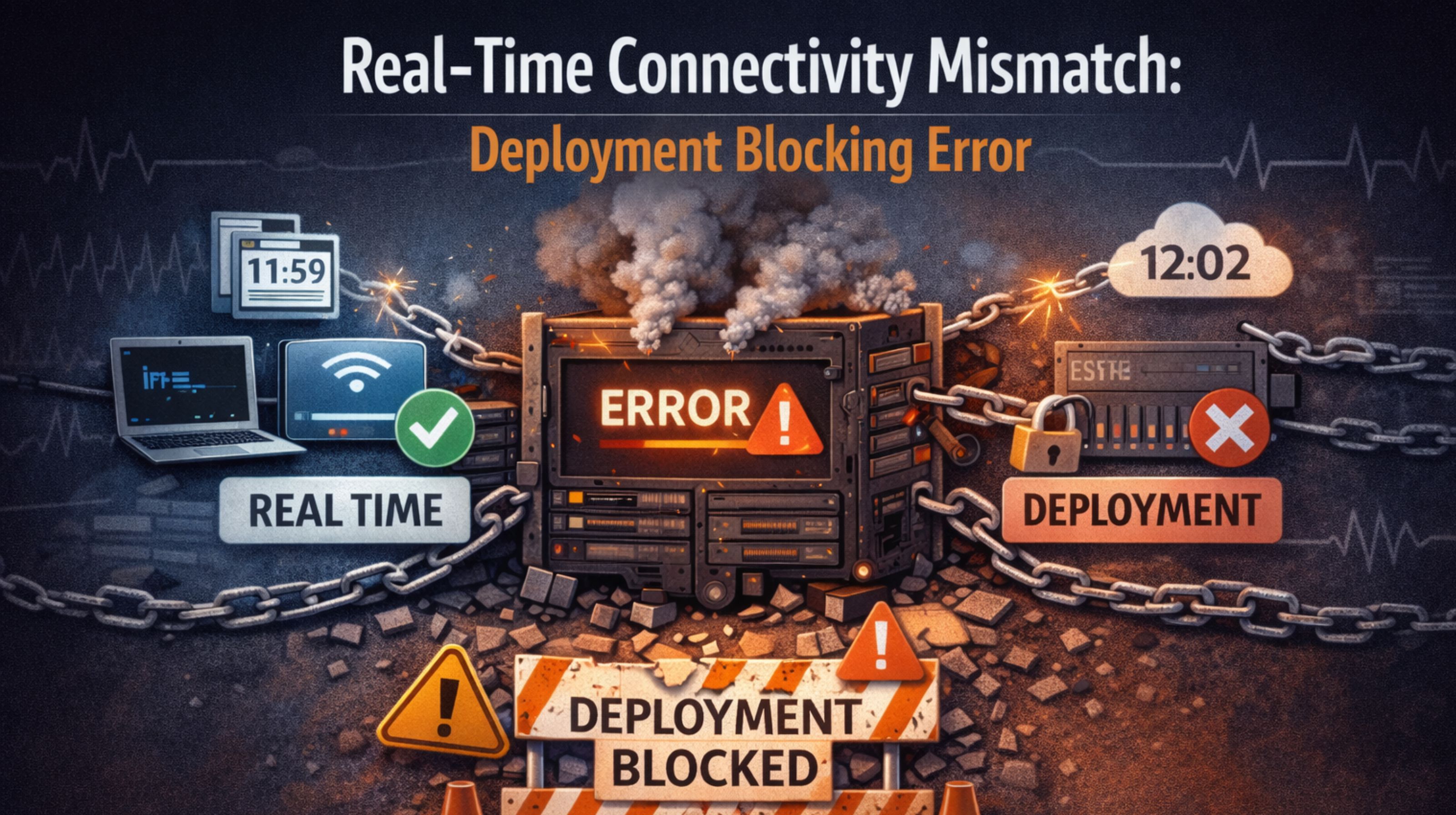
Real-Time Connectivity Mismatch Errors That Block Your Deployment
When a real-time system fails to handshake during deployment, it's not a minor glitch—it's a hard stop. It just halts everything, commissioning gets stuck, timelines slip, and suddenly you're looking at integration risks that never showed up back in the lab.
What a Connectivity Mismatch Actually Means in the Field
In practice, a mismatch error usually means two systems are speaking incompatible dialects of the same protocol. It's often down to vendor-specific tweaks or timing tolerances that only surface under real network conditions, the kind you can't replicate in isolated testing.
The Reality Under Load: Why Errors Appear at Go-Live
During final commissioning, network latency and actual data traffic introduce micro-delays that cause timeouts. Think about a controller expecting a response within 50ms—it might just fail if the reply takes 52ms. That's a condition that rarely, if ever, gets properly simulated in pre-deployment checks.
Common Mistakes That Guarantee a Deployment Block
The most frequent error is assuming protocol compliance means plug-and-play interoperability. Teams often miss the small print: a BACnet MS/TP device's baud rate has to match the master's exactly, or a Modbus TCP device might be sitting on a non-standard TCP port, leading to a silent rejection that tells you nothing.
How to Decide Your Next Move When Blocked
First, you have to isolate whether the failure is in the session establishment or the data exchange itself. Get a protocol analyzer on it to capture the exact failure frame. That decision point is crucial—it tells you if you need a gateway, a quick configuration patch, or a deeper protocol health audit to actually resolve the root cause.
FAQ
Question: What is a real-time connectivity mismatch?
Answer: It's a failure in that initial communication handshake between devices or systems. The timing, data format, or session parameters just don't align, so no data exchange can even start.
Question: Can these errors cause permanent damage?
Answer: They won't physically break anything, but the damage is real—irreversible project delays, cost overruns, and system lockouts that can force you into a complete re-commissioning cycle to fix.
Question: Do mismatches get worse at scale?
Answer: Absolutely. In large deployments, like building automation or utility grids, a single mismatch can cascade. It can block the integration of entire subsystems, making the problem exponentially harder to trace and untangle.
Question: Should we roll back or push forward when blocked?
Answer: It really hinges on fault isolation. If the mismatch is just between one device pair, a targeted fix might work. But if it's systemic, rolling back to diagnose the core integration flaw—maybe with a service like snipcol—is usually the safer path. Pushing forward risks compounding the failures.