PROFINET to cloud data bridge without PLC replacement 2026
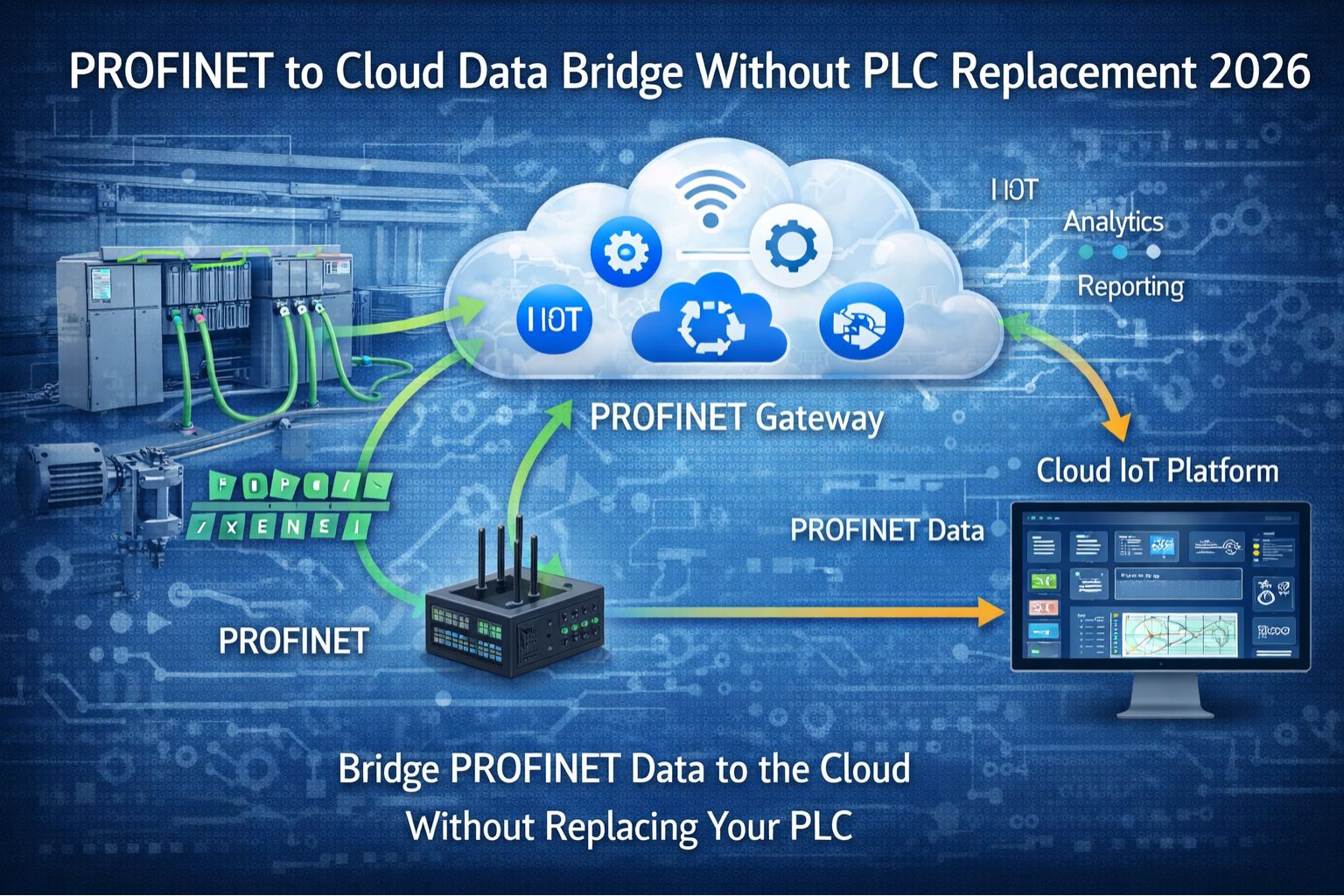
PROFINET to cloud data bridge without PLC replacement 2026
So you're looking at building a PROFINET to cloud data bridge without replacing PLCs in 2026. That means navigating protocol translation at the edge, where real-time cyclic data meets asynchronous cloud ingestion. It's a fundamental mismatch that tends to break under load. The core challenge isn't really connectivity—it's preserving deterministic I/O data context across a stateless bridge. That's the detail people often ignore, right up until the machine state telemetry becomes unreliable.
What a PROFINET cloud bridge really means for your OT data
In real IT/OT integration environments, this bridge acts as a protocol translator. It strips PROFINET's real-time, cyclic I/O data from the controller and repackages it for MQTT or REST APIs. The immediate clarity loss is the deterministic timing context. Cloud systems get a stream of values, but they can't reconstruct the machine's operational sequence or state logic. That leads to analytics that misinterpret cause and effect in the production workflow, which is a pretty big problem.
The reality of live data ingestion at industrial scale
Under live industrial scale, the bridge's packet buffering and queue management become the failure point. PROFINET cycles at sub-millisecond intervals, but cloud ingestion introduces variable latency. When a sensor polling burst or machine cycle peak hits, the translation gateway's internal buffers can overflow, dropping packets silently. Your cloud dashboard might still show data, but critical state transitions are missing. It creates these invisible gaps in operational intelligence that you only notice later.
The hidden mistake: assuming protocol translation is enough
The common misunderstanding that causes system instability is treating the PLC as a simple data source. PLCs execute control logic; their I/O data is meaningless without the ladder logic or function block context. A bridge that only translates the protocol without interpreting the control program's state machine will send "Motor ON" signals to the cloud but miss the "Overload Fault" flag from the same controller. You end up with a dangerously incomplete picture.
When to tune, reconfigure, or redesign the bridge
The decision boundary is usually clear. If data gaps or sequence errors appear only during peak cycles, you can probably tune buffer sizes and polling rates. If the control logic's state context is lost, you have to reconfigure the bridge with application-aware tagging. But when the need for sub-second, stateful machine-to-cloud synchronization arises—which is common in predictive quality or energy optimization—internal fixes just aren't enough. That's when a redesign using a state-aware protocol engine becomes necessary to preserve operational integrity.
FAQ
Question: Can you get real-time PROFINET data to the cloud without changing the PLC?
Answer: You can get near-real-time data, but true real-time determinism is lost in translation. The cloud sees a delayed, state-agnostic stream of values, not a synchronous machine state.
Question: What is the biggest risk in using a PROFINET to MQTT bridge?
Answer: The biggest risk is silent data loss during network or processing latency spikes. The bridge drops I/O packets without alerting anyone, creating undetected gaps in time-series analytics.
Question: How does scale affect a PROFINET cloud bridge's reliability?
Answer: At scale, multiple controllers and high I/O point counts overwhelm the gateway's CPU and memory. Minor latency turns into cascading buffer overflows, making the data unusable for closed-loop applications.
Question: When should you stop trying to fix a custom bridge and look for another solution?
Answer: Stop when you need guaranteed data integrity for audit compliance, or when machine-state synchronization is critical. This is where foundational protocol translation fails and a context-aware integration platform like snipcol becomes the viable path.