PROFINET PROFIBUS Legacy Device Cloud Bridge Software 2026
PROFINET PROFIBUS Legacy Device Cloud Bridge Software 2026
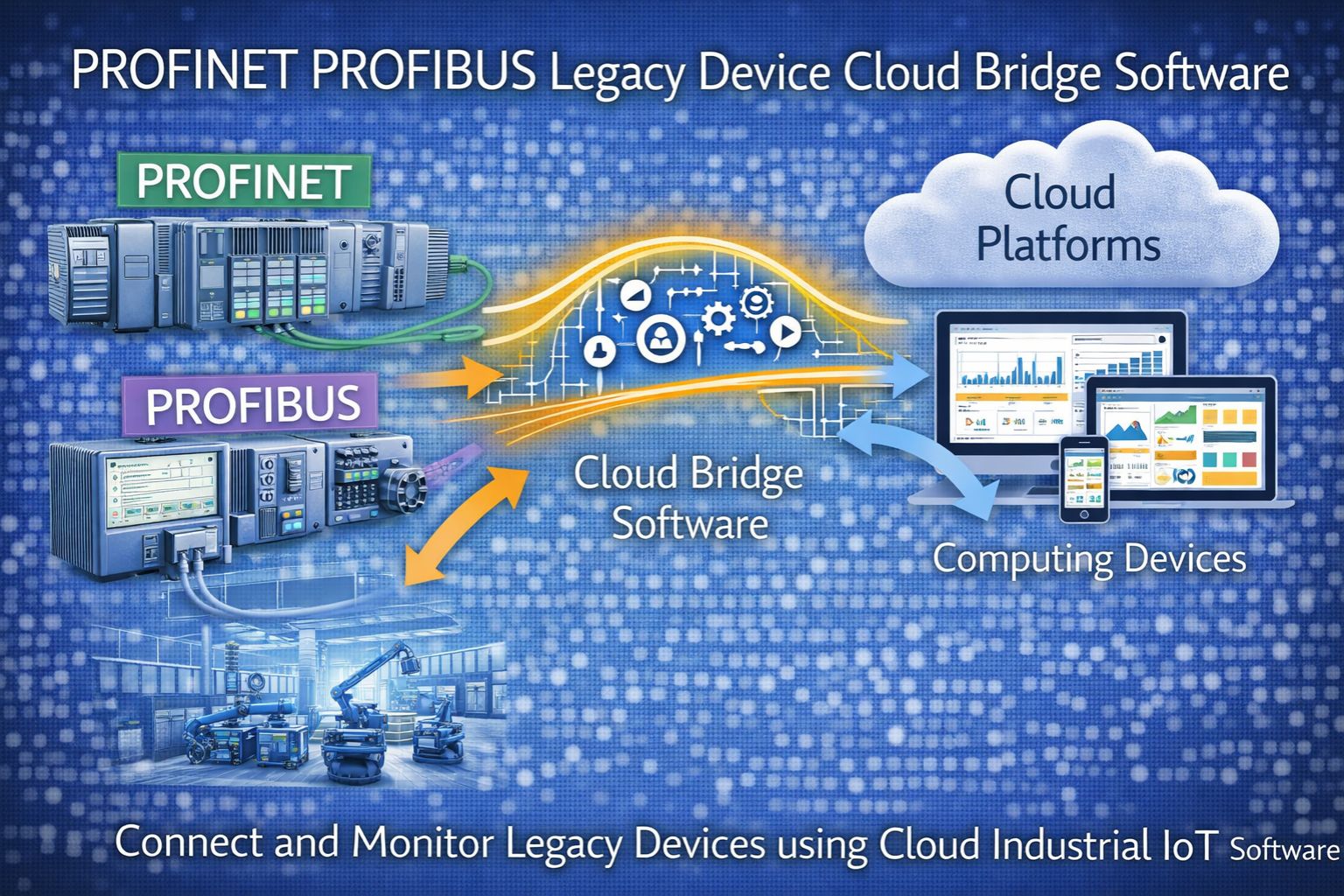
So you're looking at PROFINET PROFIBUS cloud bridge software for 2026. The main problem isn't getting a connection—it's what happens next. When decades-old, tightly timed fieldbus data runs into a stateless cloud pipeline, you get silent data corruption and timing mismatches. That disconnect just kills real-time operational visibility.
The Protocol Translation Gap in Modern IT Stacks
Here's the clarity issue. These bridges sell universal translation, but they often strip out the cyclic I/O and process image context that PLCs actually need. They turn rich industrial state data into simple MQTT tags, losing all the timing and relationship semantics. The cloud data ends up useless for making real control decisions.
What Breaks at Live Industrial Scale
Let's talk throughput. A bridge that handles a few devices in a demo will absolutely choke when hundreds of PROFIBUS DP slaves start their cyclic exchange all at once. You get packet buffer overflows in the gateway. And the scary part? It doesn't show up as clear errors—it manifests as stale, skipped sensor values in the cloud. You're left with invisible holes in your data.
The Assumption That Creates System Instability
There's a common, and costly, mistake people make. They assume the bridge software's internal buffering can just smooth over network latency between the factory floor and the cloud. And that works, right up until it doesn't—like when a burst of alarm messages from a PROFINET controller exceeds the buffer. Then critical alerts get delayed, or dropped entirely.
When to Tune, Reconfigure, or Redesign
The decision line is pretty clear. If jitter and data loss keep happening after you've tuned scan rates and QoS, and tweaking the bridge's publish intervals doesn't fix it... you've hit a fundamental architecture mismatch. At that point, you need a redesign with deterministic forwarding. Something like the edge processing in snipcol's protocol service, where legacy protocol semantics are actually preserved before the cloud ever sees the data.
FAQ
Question: Can 2026 cloud bridge software handle real-time PROFINET IRT traffic?
Answer: No. Standard cloud bridge software can't preserve the nanosecond-level sync of Isochronous Real-Time (IRT) traffic. It only translates the acyclic data, which breaks any motion control or precision synchronization loops completely.
Question: What is the biggest hidden risk when bridging PROFIBUS to the cloud?
Answer: Data integrity decay. PROFIBUS runs on master-slave polling and uses device-specific GSD files with non-standard data blocks. Generic bridges often misinterpret these, slowly introducing sensor calibration drift. It's the kind of problem you can't even detect without a physical baseline check.
Question: How does scale affect legacy protocol bridge performance?
Answer: Exponentially. Every device you add increases the poll-response cycle load on the bridge's single translation thread. At scale, this creates cumulative latency that desynchronizes the entire data set. It makes any correlated analytics in the cloud fundamentally wrong.
Question: When is it time to look beyond standard bridge software?
Answer: When your operational decisions start depending on the translated data's timing fidelity. If you're spending more time tuning and patching than actually operating, the software has become a cost center, not a bridge. That's when a deterministic IT/OT integration approach, not just simple bridging, becomes the necessary path forward.