Predictive Maintenance Sensor Data Protocol Bridge Software 2026
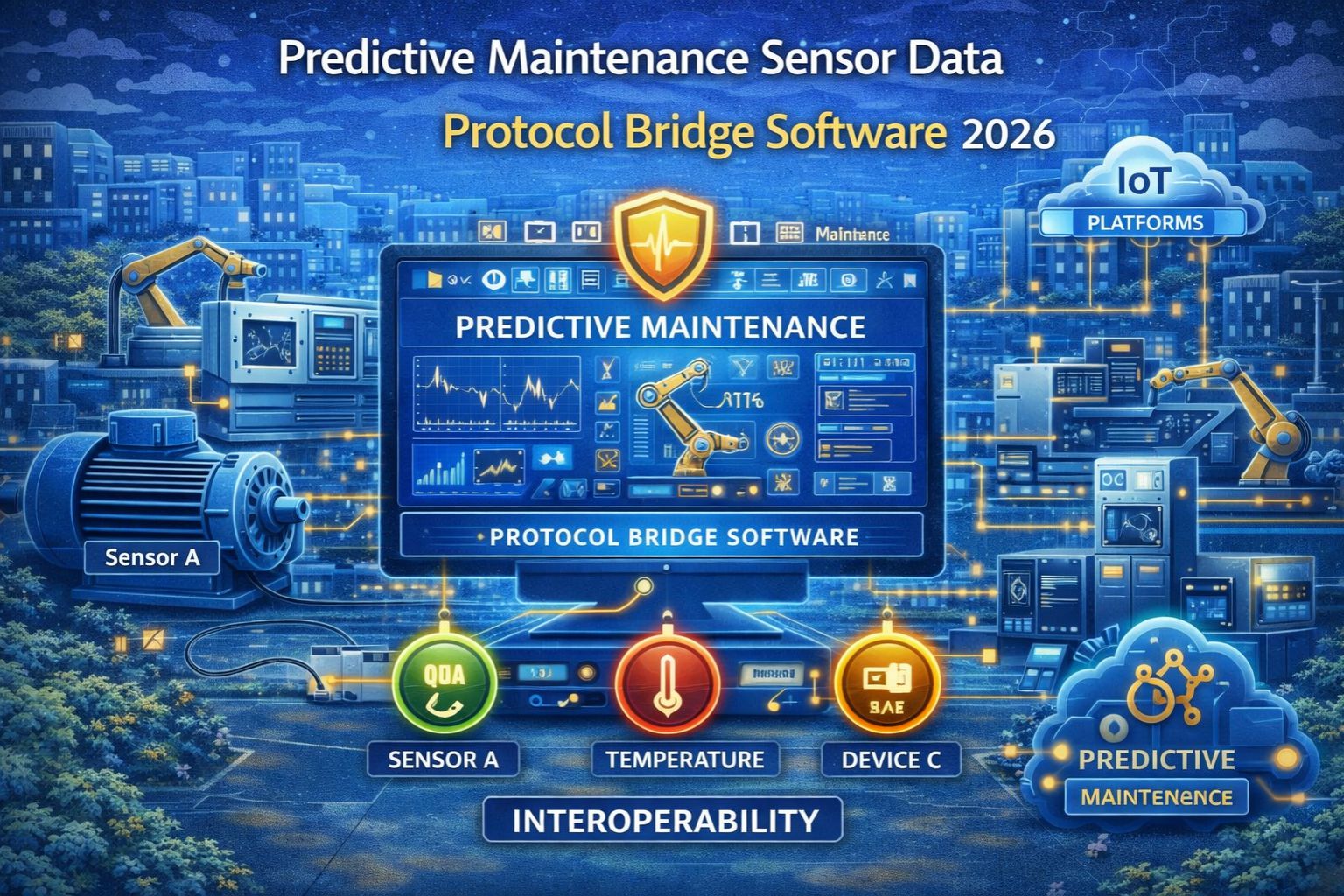
Predictive Maintenance Sensor Data Protocol Bridge Software 2026
So, in 2026, the main job of this bridge software isn't just about translating protocols. It's really about keeping the data stream whole—right there on a live factory floor with all its vibration, electromagnetic noise, and sudden bursts of data. Because if you drop just one vibration signature, you might completely miss the signs of a bearing about to fail.
What Protocol Bridge Software Actually Means for Predictive Maintenance
Think of this software as the essential interpreter. It sits between high-frequency sensor protocols—things like IO-Link, EtherCAT, or those proprietary vibration sensor outputs—and the IT systems (your cloud analytics, your CMMS) that are hungry for that data. But its real function? It has to buffer, sequence, and timestamp millions of data points every single hour, and do it without creating gaps. Because if there are gaps, the machine learning models will just read that as 'normal' operation. Honestly, that's probably the most common reason for false-negative alerts in early rollouts.
The Reality of Sensor Data Streams at Industrial Scale
Here's the reality on the ground: one machine might have dozens of sensors all polling at sub-millisecond rates. The bridge software has to deal with connection storms when a machine starts up, it has to know to prioritize a critical temperature spike over routine vibration data, and it needs to manage local buffering when the network to the cloud gets slow. And a thing teams often overlook? The bridge's own CPU and memory use. That becomes the silent bottleneck, forcing the software into "data thinning"—where it just samples every other point to stay afloat. That completely destroys the waveform integrity you need for an accurate prediction.
The Critical Mistake: Assuming the Bridge is Just a Pass-Through
The most dangerous assumption you can make is treating this bridge like a simple protocol converter. That mindset leads to configurations that ignore packet retry limits, or sensor heartbeat timeouts that don't match up, or the jitter that encryption overhead adds. The instability that results isn't a constant, obvious failure. It's intermittent data corruption. That creates these 'phantom' trends in the predictive dashboard, so maintenance teams end up chasing problems that aren't there. Or worse, they miss the real ones. This flaw directly eats away at the ROI of the whole predictive maintenance investment.
When to Tune, Reconfigure, or Replace Your Bridge Software
The line is pretty clear. If your team is constantly tweaking polling rates, increasing buffer sizes, or seeing 'data gap' alerts pop up in the analytics platform, you're in tuning mode. When those fixes only work for a few days or weeks before the issues come back, or when adding a new type of sensor breaks the data flow from your existing ones, then you probably need a protocol health audit and likely a full software reconfiguration. Replacement becomes the only real option when the software can't natively handle the mix of protocols you need, when it lacks deterministic data handling guarantees, or when its architecture just can't scale to your sensor count without losing data. That's the point where you have to seriously look at specialized integration engines.
FAQ
Question: What is the biggest bottleneck in predictive maintenance data flow?
Answer: Usually, it's the protocol bridge's own ability to handle all those concurrent high-frequency streams without losing packets or adding too much jitter. People blame the network, but it's rarely the main culprit. The real issue is usually the translation and buffering logic inside the bridge software itself.
Question: Can we just use a more powerful server for the bridge software?
Answer: You can try throwing hardware at it, but you get diminishing returns. If the software's architecture isn't deterministic—meaning it can't guarantee data delivery within a required time window—then more CPU just puts off the inevitable collapse when the peak load hits.
Question: How do data gaps affect machine learning models for prediction?
Answer: Gaps create these misleading 'flatlines' in the time-series data. The model might see that and think it's just stable operation, so it fails to detect the rising amplitude of a vibration trend that comes right before a failure. It corrupts both the training data and any future predictions.
Question: When is it time to look beyond our current bridge solution?
Answer: When the cost of all the engineering workarounds, plus the data integrity risks, plus the missed maintenance events, starts to exceed the cost of a robust, purpose-built solution. That's the tipping point. It's when your foundational IT/OT integration strategy, not just tactical fixes, starts to determine whether your predictive maintenance actually succeeds.