PLC Timeout Causing Batch Production Loss: Root Cause & Prevention
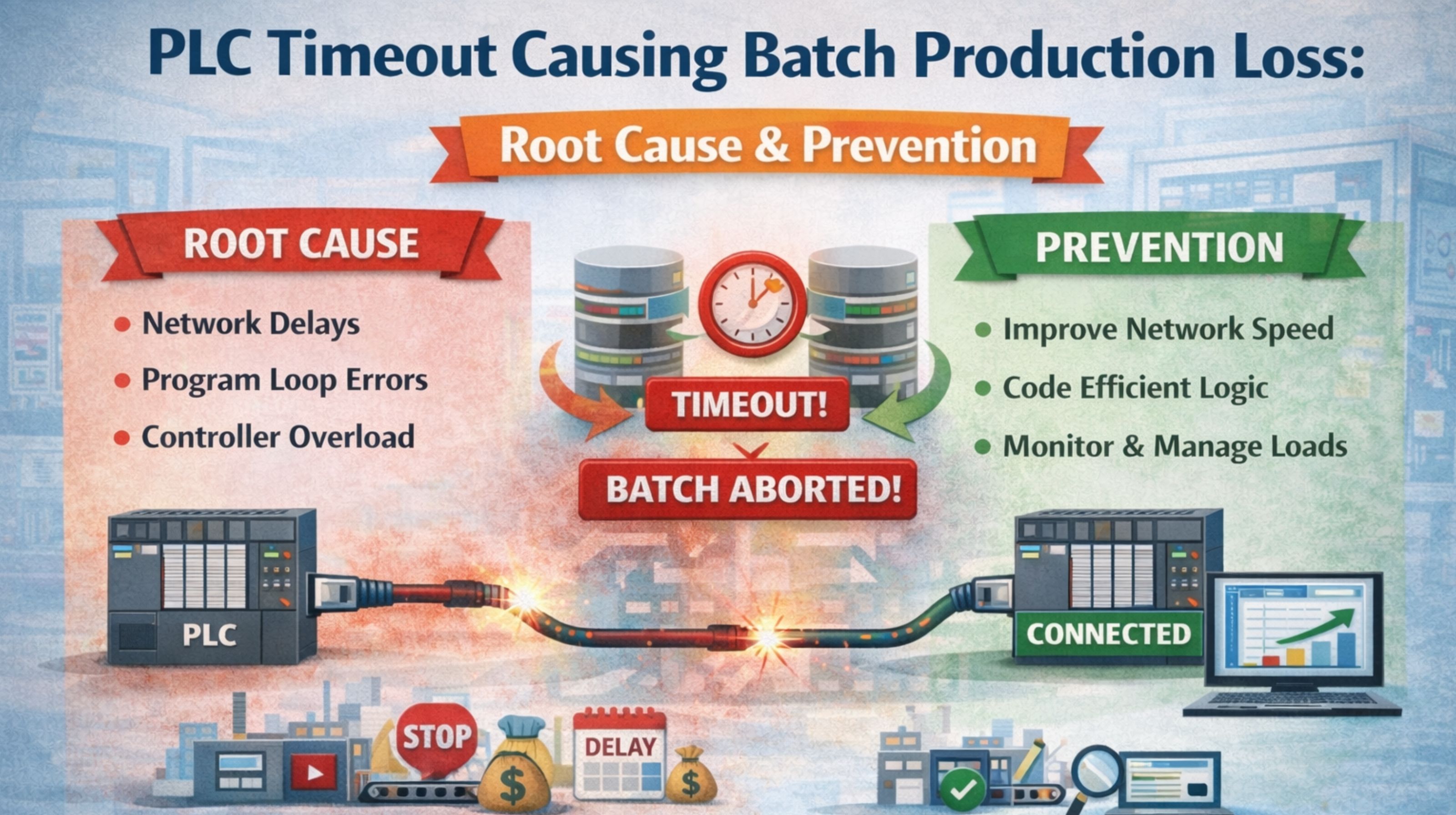
PLC Timeout Causing Batch Production Loss: Root Cause & Prevention
Look, PLC communication timeouts aren't just network glitches. They're a direct signal of an architectural mismatch—the kind that halts batch cycles, corrupts product, and triggers those costly commissioning delays we all dread. The root cause is almost never a single setting. It's the collision between what a legacy protocol expects and what modern industrial integration demands, especially under real production load.
The Real Meaning of a PLC Timeout in Batch Control
In batch production, a timeout means a control command or data poll just didn't finish in time. The recipe step stalls or fails. Usually, this points to deeper industrial protocol integration issues. Think mismatched timing: the PLC's scan cycle, the supervisory system's request rate, and network latency all fighting each other, creating a fragile handshake. The business impact is immediate. You lose batch integrity, waste material, and blow right through production SLAs.
What Happens Under Scale and During Commissioning
During normal operation, a little latency might get absorbed. But throw in the burst load of starting a new batch, or push it during final commissioning, and those frailties collapse. Timeouts start to cascade as gateways get overwhelmed, leading to malformed packets or a complete handshake abandonment. Here's the non-obvious part: tuning timeouts in isolation often fails. The underlying transport mismatch is still there—like a Modbus TCP master waiting for synchronous replies from an asynchronous OPC UA server. That's when integration instability turns into a project-blocking audit exposure.
Common Mistakes and Where Tuning Stops Working
A classic mistake is treating timeout values as purely a network config problem. Teams crank up the PLC timeout parameters, only to face a different PLC communication failure because response buffers get starved or corrupted. Tuning hits a wall at the boundary of protocol semantics. For instance, when a legacy system physically can't acknowledge a modern packet structure fast enough, or when certificate validation in a secure channel introduces clock skew. Getting this wrong is what causes those massive deployment delays and expensive integration rework.
Decision Help: Patch, Redesign, or Replace Architecture
When you're facing recurring timeouts, you have to decide: patch it, redesign the comms layer, or replace the architecture? Patching might work for an isolated node. But for system-wide gateway timeout under load, you need a protocol audit and an architectural review. This usually means assessing whether your middleware can actually manage protocol coordination and stateful fallback logic across all your different assets. More often than not, the decision creates pressure to move toward a system redesign that kills the timing mismatch at the source.
FAQ
Question: Is a PLC timeout usually just a network cable or switch problem?
Answer: Rarely, in modern systems. Sure, physical layer issues can cause them. But persistent timeouts in batch control? That's typically a symptom of a protocol or application-layer mismatch. Like the request/response timing between your SCADA and the PLC logic being completely out of sync.
Question: What's the operational risk if we just keep increasing the timeout value?
Answer: You're just masking the symptom and introducing bigger risks. Longer timeouts can make the control system hang, delaying fault detection. You might even let a defective batch proceed further down the line, which increases waste and opens up safety or compliance exposures.
Question: Why do timeouts suddenly appear during system commissioning or after a software update?
Answer: That's when you hit the scale and concurrency ceilings. Commissioning tests the full system load. Updates can change packet handling or add security overhead. The existing architecture hits a hidden throughput limit, or a new OPC UA compatibility handshake fails and starts a cascade.
Question: When should we consider an architectural replacement instead of continued troubleshooting?
Answer: When timeouts keep happening during specific batch phases, affect multiple lines, or need constant manual fixes. That's a core mismatch signal. At that point, you need to evaluate a system redesign or a platform that can handle stateful protocol coordination, otherwise you'll just keep losing batches.