Machine Spindle Load Data OPC UA Cloud Integration Middleware 2026
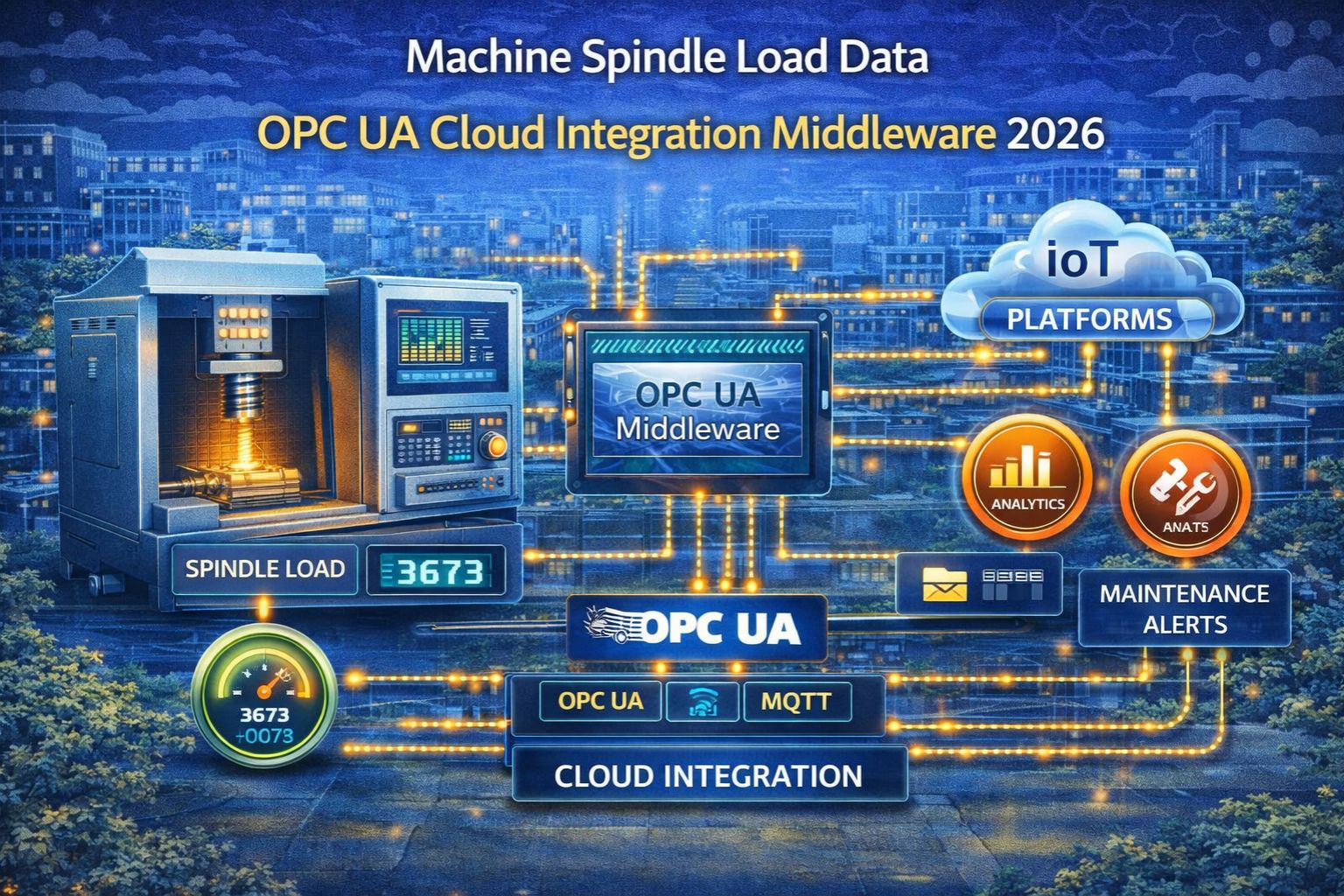
Machine Spindle Load Data OPC UA Cloud Integration Middleware 2026
So you're trying to get high-frequency spindle load data from OPC UA servers up to the cloud. There's a bottleneck in the middleware that a lot of the 2026 blueprints seem to miss. It's not just a lag—it's where the protocol translation and data buffering quietly mess up the real-time condition monitoring you're counting on for predictive maintenance.
What Spindle Load Integration Really Means for OT Teams
For OT teams, this isn't just moving numbers. It's about keeping those millisecond-level load swings and torque signatures from your CNC machines intact. Those tiny fluctuations tell you about tool wear, weird material, or a bearing about to go. And they're the first things to get averaged out or just lost when the data hits a queuing layer.
The Live Data Reality at Industrial Scale
In a real plant, one OPC UA server might be streaming data from dozens of spindles at once. If your middleware isn't built for that kind of industrial telemetry volume, it starts buffering packets. Before you know it, your time-series data arrives at the cloud out of order, and your vibration-load correlation analytics are basically useless.
The Hidden Mistake in 2026 Architectures
The big mistake? Assuming a generic IoT gateway or a standard cloud message broker can handle OPC UA's structured data and the subscription rates for spindle metrics. That mismatch leads to silent data thinning—where maybe only every fifth sample makes it through. You end up missing the exact transient overload events you set this up to catch.
When to Tune, Reconfigure, or Replace the Middleware
You can try tuning timeouts and sample rates if the latency is under 500ms and data loss is just occasional. But if you're seeing consistent buffering or schema conversion errors, you need to reconfigure or build a new data pipeline. And replacement becomes necessary when your internal fixes can't keep the data accurate enough for predictive model accuracy. That's usually the line where standard middleware just gives up.
FAQ
-
Question: What is OPC UA spindle load data?
-
Answer: It's the real-time telemetry from a machine tool's spinning spindle—measuring force and power draw. You use it to monitor performance, tool health, and spot process weirdness. It's usually published using the OPC UA industrial protocol.
-
Question: Why does middleware fail with this data?
-
Answer: Too often, middleware treats it like any other sensor reading. It doesn't get the need for high-frequency, perfectly ordered time-series delivery. So it buffers, aggregates, and loses the micro-trends that your analysis actually depends on.
-
Question: How does this break predictive maintenance?
-
Answer: Predictive models need precise load patterns over time. If the data is delayed or thinned out, you get false negatives. A tool that's about to fail looks fine on the dashboard... right up until it breaks and causes unplanned downtime and damage.
-
Answer: The tipping point is when data latency consistently blows past your model's required sampling window, making your analytics unreliable. That's when you have to start looking at specialized integration engines, like snipcol, to see if they can actually preserve your data integrity.