IP camera PTZ control integration with industrial protocol platform
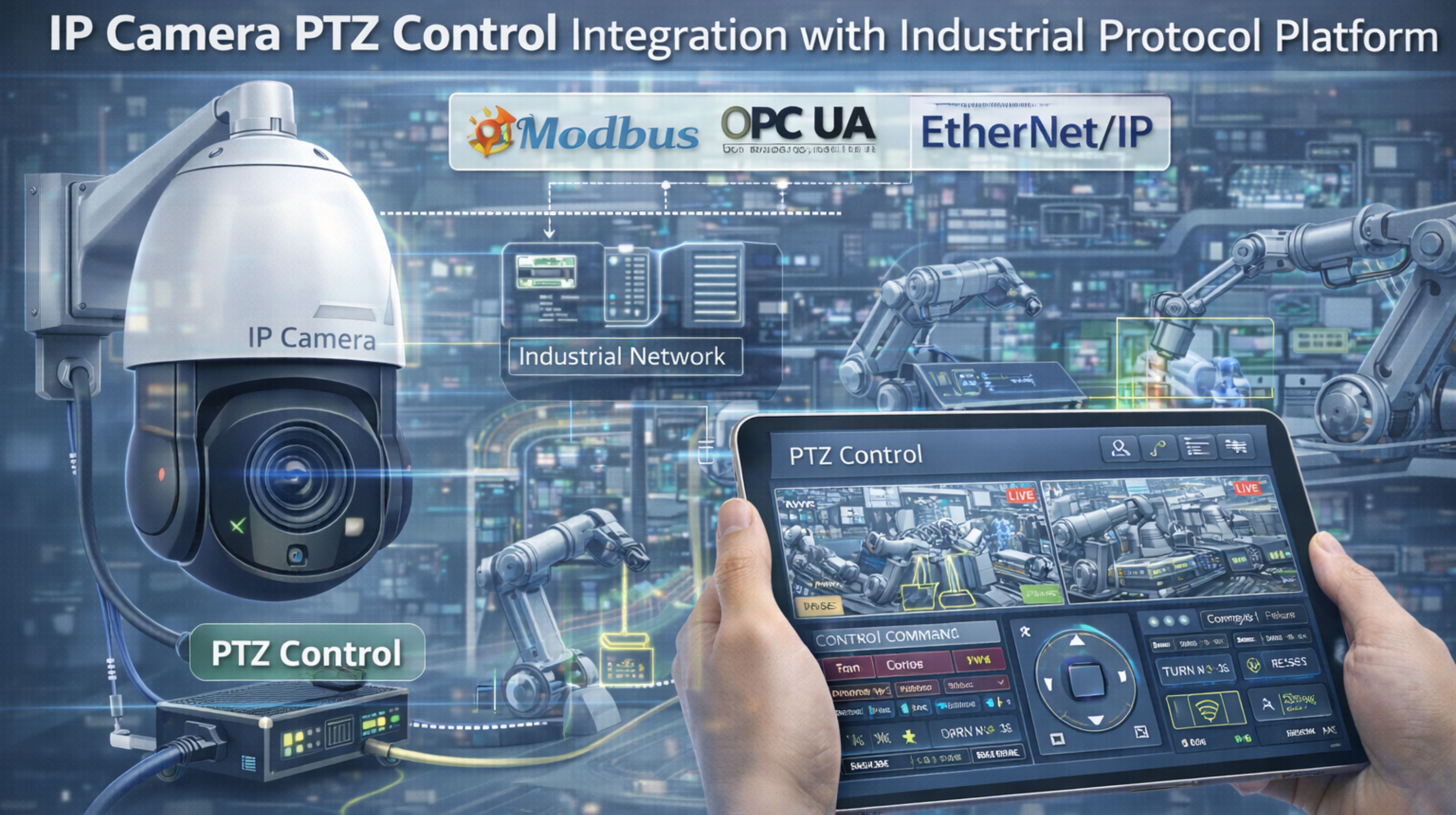
IP camera PTZ control integration with industrial protocol platform
When you try to map IP camera PTZ commands onto an industrial protocol platform like OPC UA or Modbus TCP, the first thing you notice is the timing mismatch. Industrial systems poll data in seconds, while PTZ control expects sub-second acknowledgment. That creates a command lag operators feel immediately—the camera movement just feels sluggish and unresponsive.
The clarity gap between IT video and OT control
The real integration problem isn't connectivity; it's translating intent. Industrial protocols are built for state reporting and collecting process variables, not for streaming low-latency commands like "pan left at speed 5." Teams often assume a simple gateway will translate VMS API calls into industrial tags, but they miss the stateful nature of PTZ control. The camera needs a continuous command flow until told to stop, while industrial platforms typically send a single write command and assume the action is done.
Reality check under live industrial network load
On a live plant floor, the industrial network is already saturated with sensor telemetry and PLC data. Introducing PTZ command traffic—especially during an alarm when multiple cameras might need to move at once—creates packet collision and buffer overflow in the gateway. This isn't just simulated latency; it's dropped commands where the camera doesn't move at all. That leaves security or inspection blind spots right when you need them most. The platform's scan cycle, which is optimized for process data, becomes the bottleneck for real-time visual control.
The silent mistake: assuming protocol parity
The most common failure is assuming the industrial protocol platform can handle PTZ as just another set of writable tags. But camera control usually uses session-based, keep-alive communication (like ONVIF or proprietary HTTP APIs) that doesn't map cleanly to the write-once, read-many architecture of industrial data highways. This mismatch causes command "ghosting"—the platform shows the command was sent, but the camera never got it, or got commands out of sequence, leading to jerky movement. Operators lose trust and often revert to manual local control, which defeats the whole point of integration.
Decision help: when to tune, reconfigure, or redesign
The decision line is pretty clear. If your camera movement latency exceeds 2-3 seconds and operators complain about lag, start by tuning gateway timeouts and scan rates. If commands are still getting dropped during high network use or with multiple cameras, you'll likely need to reconfigure the architecture—maybe setting up a dedicated command channel that bypasses the main industrial data bus. But when the core requirement is sub-second, reliable PTZ response tied to SCADA alarms, and internal fixes aren't working, you're looking at a redesign. That's where a purpose-built protocol integration layer that understands both real-time control and industrial data context becomes necessary, not just a nice-to-have.
FAQ
Question: Can Modbus TCP handle IP camera PTZ control?
Answer: Technically, yes. But reliably? No. Modbus TCP is a polled protocol with no built-in real-time or session management. It can send a move command, but it can't manage the continuous stream of speed and position updates needed for smooth PTZ operation. The result is choppy camera movement and a high risk of commands getting lost.
Question: Why does PTZ control fail when integrated with OPC UA?
Answer: OPC UA is great for data modeling and secure information exchange. But its publish-subscribe mechanisms are optimized for data aggregation, not for low-latency command-and-control. The security negotiation and session overhead add delays that break the immediate feedback loop between an operator's joystick and the camera movement.
Question: What's the biggest risk in merging camera control with SCADA protocols?
Answer: The biggest risk is system instability during an alarm. When a SCADA alarm floods the network with high-priority process data, PTZ commands get queued or dropped—precisely when operators need to visually investigate the alarm source. It creates a critical blind spot for both security and operations.
Answer: You need a redesign when operators start bypassing the integrated system because of lag, or when latency measurements consistently show multi-second delays even after network tuning. That points to a fundamental protocol architecture mismatch. At that stage, exploring a contextual integration platform like snipcol, which can handle stateful control streams alongside industrial data, becomes a necessary step to actually make the workflow work.