IEC 61850 Substation Protocol Integration Middleware Software
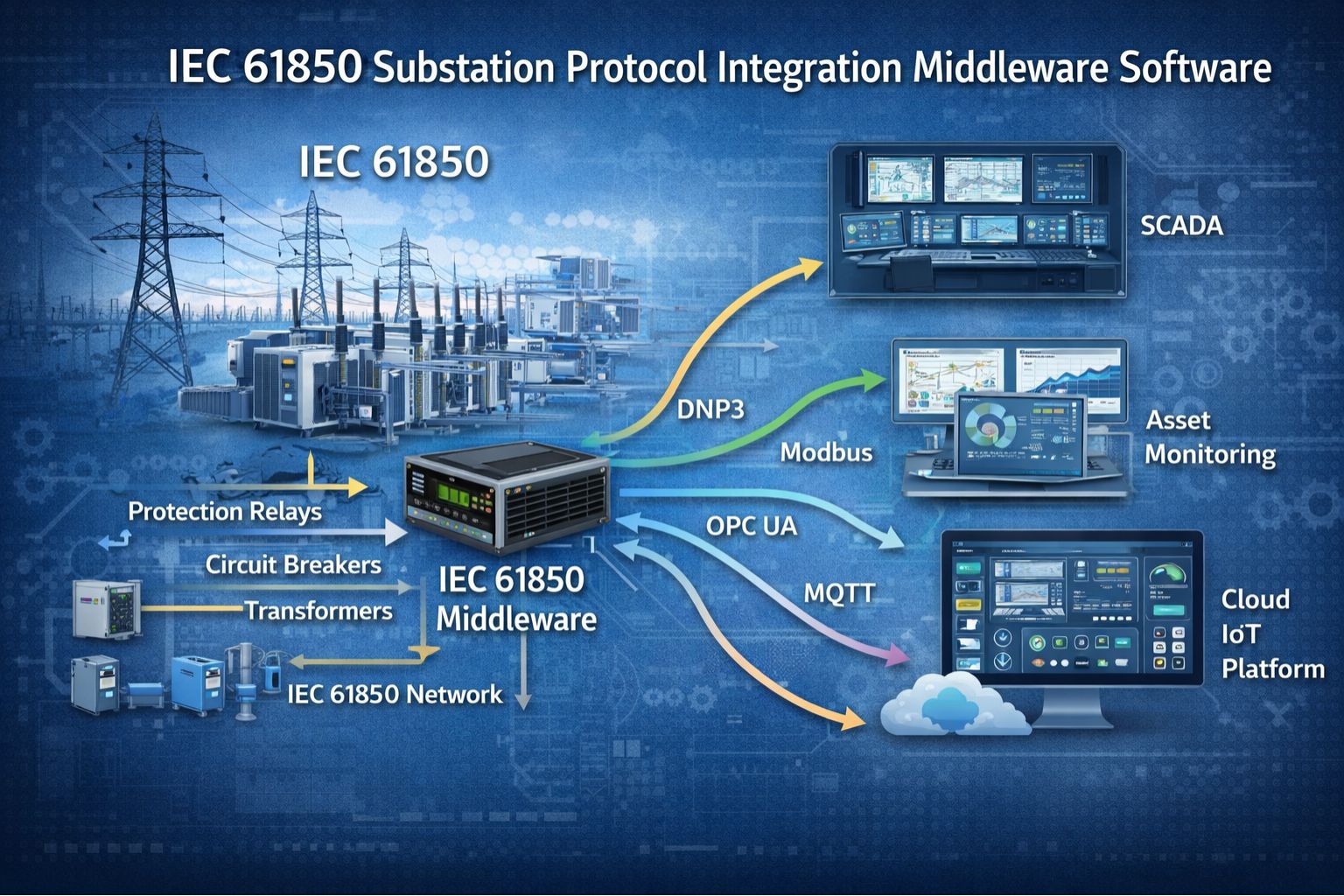
IEC 61850 Substation Protocol Integration Middleware Software
When IEC 61850 middleware fails, it's rarely just a bug. It's more like a cascade—MMS and GOOSE traffic piles up and overwhelms the translation layer, so critical telemetry drops before it ever gets to SCADA or the historian. What you get is this silent gap. Operators think the system is stable, but protection events and equipment status updates are just gone, lost to buffer overflows. It's the kind of non-obvious detail teams miss completely, until a fault analysis shows your sequence-of-events records have holes in them.
What IEC 61850 Middleware Failure Means for Grid Operations
In a real IT/OT environment, this failure flips the script. The middleware stops being a bridge and becomes a bottleneck. The software has to handle burst traffic from dozens of IEDs during a fault, but a lot of solutions just buffer packets in sequence. So when new messages come in, older—but critical—GOOSE messages get discarded. The real breaking point is when substation event rates outrun the middleware's internal queue speed. And that limit? It's often not in the spec sheets.
The Reality of Live Substation Data Ingestion at Scale
At real industrial scale, the middleware's neat abstraction of IEC 61850's complex models tends to fall apart. The software might map GOOSE messages to a simple tag-based system, stripping out the vital context and timing built into the protocol. A common misunderstanding that leads to instability is assuming the middleware handles SCL configuration drift automatically. In reality, a minor IED firmware update can invalidate your whole data model mapping and just stall ingestion completely.
The Critical Mistake in Assuming Universal Protocol Translation
The main failure pattern is assuming the middleware is a universal, set-and-forget translation layer. Teams often configure it for maximum data point throughput, not for prioritizing protection signals. The result? Non-critical analog values flow smoothly, but the crucial trip signals from circuit breakers get delayed or lost. That's because the software usually lacks the deep protocol awareness to differentiate message criticality within the IEC 61850 stack itself.
Decision Help: When to Tune, Reconfigure, or Replace Your Middleware
The decision really comes down to latency under fault conditions. If you can tune your middleware—through queue prioritization or GOOSE subscription filtering—to guarantee delivery of protection messages within 4ms during simulated faults, then reconfigure it. But if internal fixes aren't enough and you're facing persistent timeouts or data model corruption, you have to redesign. That often means moving to a gateway with native, hardware-assisted protocol processing. This is where a platform like snipcol comes in, providing the deterministic processing that generic middleware usually can't.
FAQ
Question: What causes IEC 61850 middleware to timeout?
Answer: Timeouts usually happen because the middleware can't process the burst of concurrent MMS and GOOSE messages during a substation event. It overwhelms the internal buffers and TCP stacks—it's not typically a network latency issue.
Question: Can middleware software lose GOOSE messages?
Answer: Yes, absolutely. If the middleware isn't designed for real-time, lossless subscription to GOOSE streams, it'll treat them like generic multicast traffic. That leads to dropped messages when the network is busy, which can break protection schemes.
Question: How do you test middleware under real substation load?
Answer: You have to use a protocol simulator that replicates the exact IED models, SCL configuration, and fault-sequence message rates of your substation. Basic ping or throughput tests won't cut it—this is how you find the real scale constraints.
Question: When should you replace integration middleware entirely?
Answer: Replace it when tuning fails to stop data loss during routine operations, or when the middleware can't stay aligned with the substation's SCL data model without manual work after every IED update. That's a sign of a fundamental design mismatch.