IEC 61850 Power Substation Protocol Integration Middleware
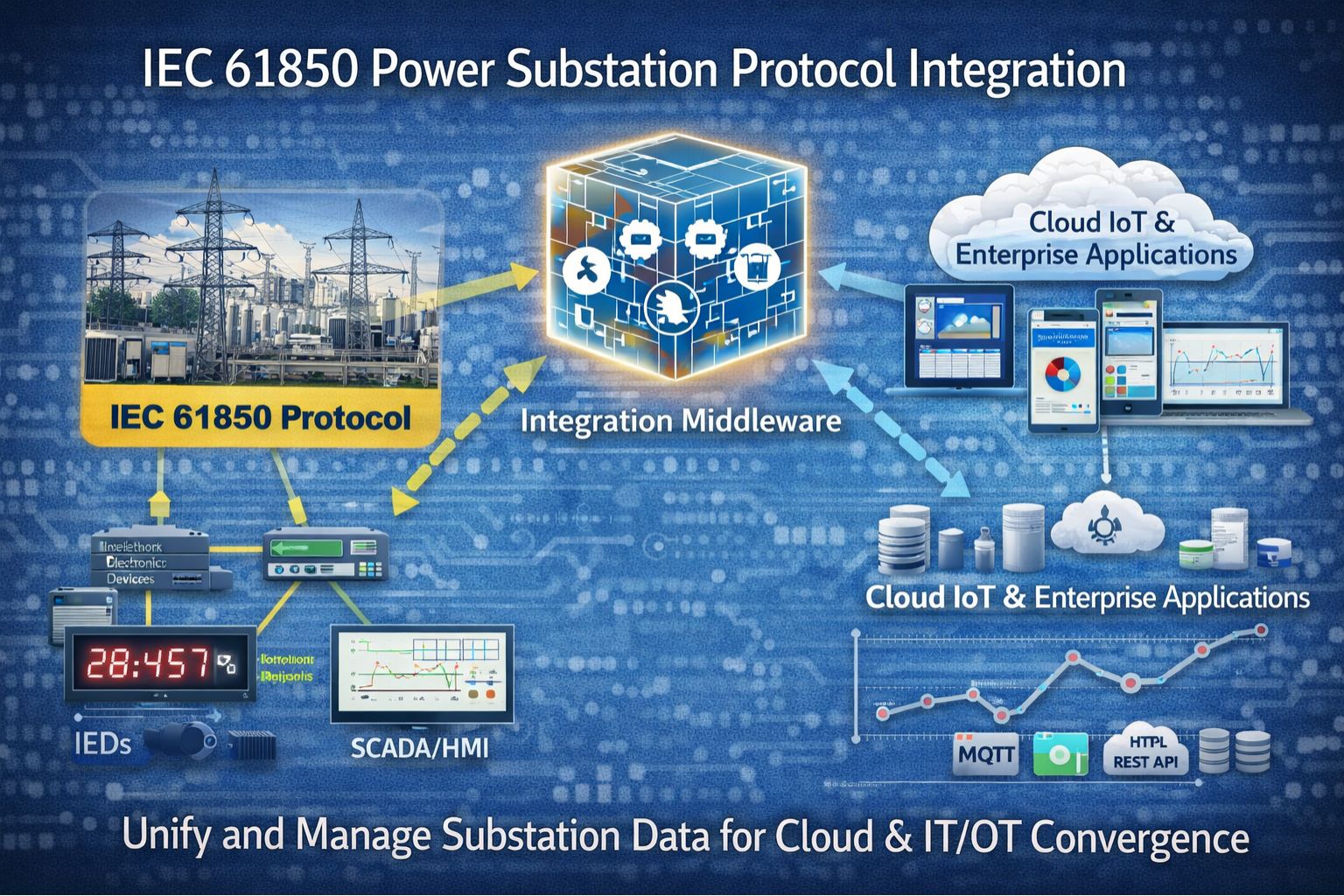
IEC 61850 Power Substation Protocol Integration Middleware
In real-world power utility integration, IEC 61850 middleware is that fragile translation layer between substation automation systems (SAS) and enterprise SCADA or analytics platforms. It's where protocol timeouts and SCL file mismatches silently break data ingestion, leaving grid operators in the dark.
What IEC 61850 Middleware Actually Does in OT Integration
This middleware isn't just a protocol converter. Its real job is mapping the complex, object-oriented data models from Substation Configuration Language (SCL) files into something IT systems can actually use. And that process fails, more often than you'd think, when gateway buffering just can't handle the burst traffic from a protection relay event report.
Where the Integration Breaks Under Live Grid Conditions
During a fault event, the middleware has to process a flood of GOOSE and Sampled Value messages within milliseconds. If the internal queue overflows—or if a mandatory dataset attribute is missing from the IED configuration—the entire data stream for that bay goes stale. Operators end up flying blind.
The Common Mistake That Destabilizes the Entire Data Pipeline
Teams often assume the middleware will handle all SCL file versions. But a mismatch between the IED's actual data model and the middleware's expected template causes critical logical nodes, like MMXU for measurements, to be mis-mapped or dropped entirely. The result? A corrupted historian.
When to Tune the Middleware Versus Redesign the Gateway Layer
You can tune timeout and buffer settings right up until you hit the physical limit of the gateway's CPU. But when latency requirements for protection schemes drop below 4ms, or when you need to integrate non-61850 legacy devices, you've hit a boundary. Internal fixes fail here, and you need to redesign the architecture. This is where specialized solutions like snipcol become necessary.
FAQ
Question: What is IEC 61850 integration middleware?
Answer: It's software, usually running on a gateway, that translates the real-time IEC 61850 protocol—GOOSE, MMS, SV—and its complex data models into formats like OPC UA or MQTT for IT systems. It's the critical bridge between the substation and the control center.
Question: Why does IEC 61850 middleware fail?
Answer: Failure usually comes down to a few things: SCL file mismatches, buffering that can't handle burst traffic during faults, or protocol timeouts that don't match the substation IEDs' response times. Any of these can freeze the data stream.
Question: How does middleware affect grid operational risk?
Answer: Unstable middleware introduces latency or data loss in protection and monitoring schemes. That delays fault detection and operator response, which directly increases the risk of equipment damage or wider grid instability.
Question: When should we replace our IEC 61850 integration layer?
Answer: Replace it when tuning can't meet sub-10ms latency for protection data, when integrating a mix of different device protocols becomes a nightmare, or when managing SCL models becomes unmanageable. That's the signal you need a more robust, unified gateway solution.