How Does SECS GEM Semiconductor Fab Protocol Integration Work
How Does SECS GEM Semiconductor Fab Protocol Integration Work
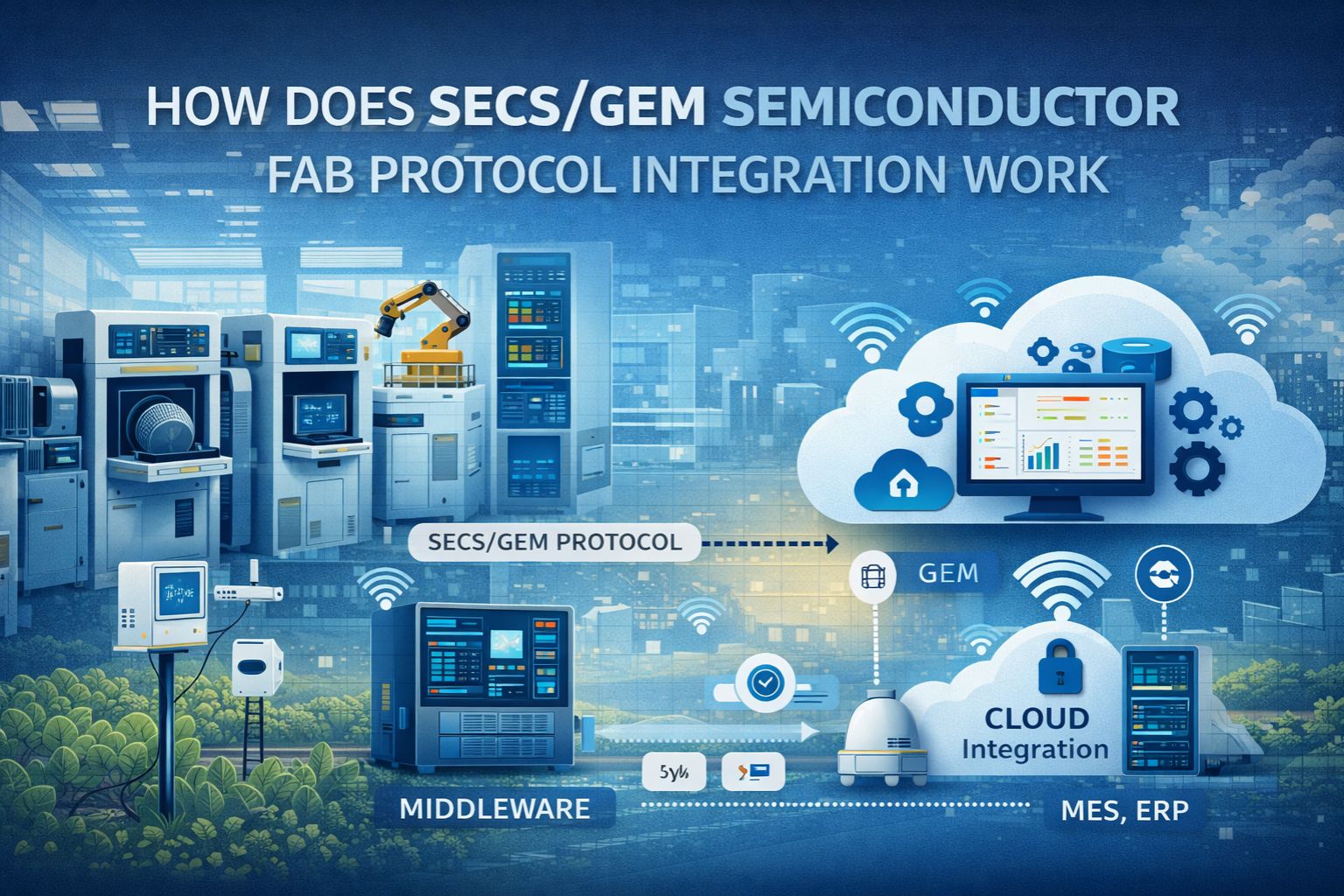
At its core, SECS GEM integration sets up a standardized communication link between a fab tool and the factory's MES or host computer. It's that link that allows data, commands, and alerts to flow both ways. This is what you need for wafer traceability, process control, and tracking OEE. But in practice, it's more than just moving data. You're building a reliable, state-aware digital thread. So the host can remotely start a process, catch an alarm—say, a pressure spike—collect wafer measurements, and tie every single action back to a specific lot ID. And all of that happens through a structured sequence of SECS-II messages, sent over an HSMS TCP/IP layer.
The Core Communication Framework of SECS GEM
The framework is a client-server setup. The fab equipment is the GEM-compliant server, and the factory host is the client. The host kicks things off by starting an HSMS TCP/IP session, then there's a handshake to set control states like ONLINE LOCAL or REMOTE. Here's a detail teams often miss: the GEM state model's impact on tool throughput. If the host botches managing the transition between states, the tool can get stuck in a "host offline" limbo. That halts automated material handling right there on the fab floor, forcing a manual reset. And that directly hits your cycle time.
Reality Check in High-Volume Production
In a live, 24/7 high-volume environment, SECS GEM integration isn't about perfect data. It's about managing constant exceptions and just keeping the connection alive across hundreds of tools. You'll run into problems like packet buffering on older tools with slow PLCs. High-frequency event reports—S6F11 for collection events, for instance—can overwhelm the tool's comms buffer. That causes dropped messages and leaves gaps in your traceability log. This mismatch, between the host expecting a steady data stream and the tool's physical limits, is a huge source of IT/OT integration headaches. It throws off OEE calculations and can even lead to compliance audit failures.
The Mistake of Treating It as a Simple Data Pipe
The biggest risk comes from thinking SECS GEM is just a data extraction protocol. Teams often configure the host to grab every available data point. They don't optimize the event report definitions or trim the collection event list. That creates massive network overhead and adds latency to critical control loops. It completely ignores the protocol's real purpose: selective, state-based communication. Things really break down when tool vendors push firmware updates that change how established SVIDs or ECIDs behave. That breaks the host-side parsing logic, leading to silent data corruption. You might not even notice until wafers start getting scrapped.
Decision Help: When to Tune, Reconfigure, or Redesign
Your decision really depends on the root cause of the failure. You can tune things—adjust HSMS timers (T3, T5, T6, T7) and buffer sizes—if you're dealing with intermittent timeouts or session drops. You need to reconfigure the GEM interface and remap event reports when adding new data points or after a tool software update. But a full redesign of the integration layer is necessary when you hit a fundamental protocol mismatch. Like trying to integrate a non-GEM legacy tool through a gateway that can't properly emulate the full state model. Or scaling to a multi-host setup where control state conflicts spiral out of control. Internal fixes won't cut it if the equipment's firmware lacks true GEM compliance. That's when you need external expertise, from a provider like snipcol, to bridge that semantic gap.
FAQ
Question: What is the difference between SECS-I, SECS-II, HSMS, and GEM?
Answer: SECS-I is the old RS-232 physical layer standard. SECS-II defines the actual message structure and content—like S1F1 for "Are You There?". HSMS is the modern TCP/IP-based transport protocol that replaced SECS-I. GEM (Generic Equipment Model) is the application-level standard. It's built on SECS-II/HSMS and defines the specific behaviors, states, and data reporting a tool must have to be integrable.
Question: Why do SECS GEM integrations fail so often in new tool installs?
Answer: Failures usually come from a few places. Sometimes the tool vendor's GEM implementation is incomplete. Other times, the host-side event report linkages are misconfigured. Network security appliances—firewalls, deep packet inspectors—can also interfere. They often mistake HSMS TCP traffic for non-industrial protocol traffic and throttle or block it.
Question: How does SECS GEM handle recipe management?
Answer: It uses dedicated message streams, mainly S7F. The host can download a process recipe (S7F3), the tool can upload its current one (S7F1), and the host can remotely start a recipe (S2F41). A common pitfall is not validating recipe parameter limits on the tool side before download, which can cause an immediate process fault.
Question: When should a fab consider moving beyond basic SECS GEM integration?
Answer: When you need real-time Advanced Process Control (APC) with sub-second feedback, or when you're integrating tools into a larger Industrial IoT setup for something like predictive maintenance. That often means you need a bridge. Something that can normalize SECS GEM data into a modern Cloud IoT pipeline, while still preserving the critical state and control logic of the original protocol.