Go-Live Configuration Errors That Halt Your Deployment
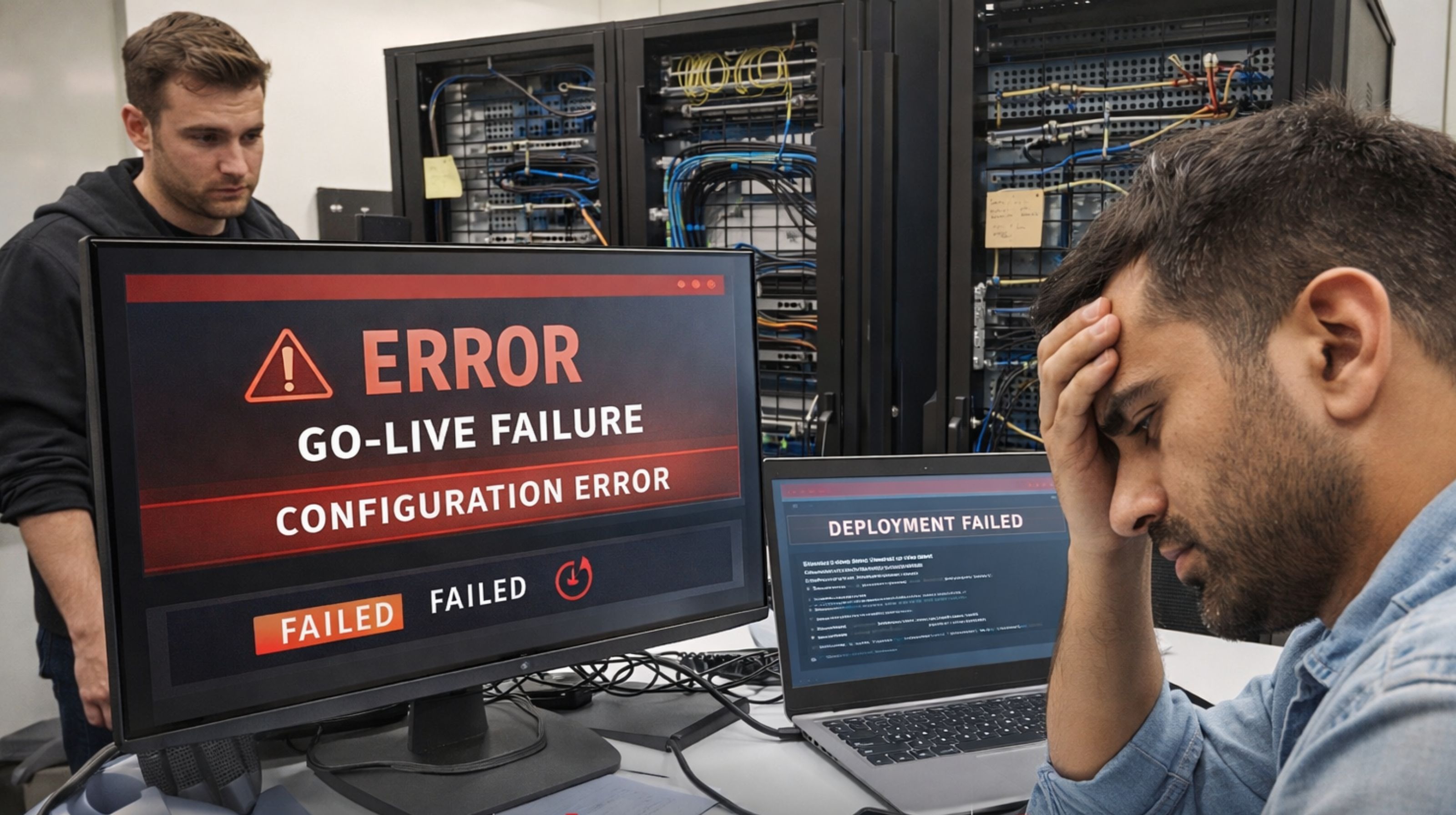
Go-Live Configuration Errors That Halt Your Deployment
Calling it a simple bug really misses the point. A go-live configuration error is more like a systemic failure—it's that moment when the mismatch between your nice, clean test environment and the messy reality of live data just brings everything to a grinding halt. Usually at the worst possible time.
What a Configuration Error Means for Your Live System
In practice, it means your system's logic is suddenly getting data it has no idea how to process. The result isn't subtle: a cascade of timeouts, safety interlocks tripping for no apparent reason, or the whole system just freezing up and refusing commands. Operators end up staring at frozen screens, completely locked out.
The Reality of System Behavior Under Live Load
Here's what teams often miss. During commissioning, you test with these perfect, predictable data streams. Real load is different. It's sensor noise, random network latency spikes, and five users trying to do things at once. That chaos exposes edge cases in your config files that nobody validated, and the central controller can just... fault. It won't fix itself, either. You're looking at a manual rollback.
Common Failure Patterns and Wrong Assumptions
The most expensive assumption? Thinking "the vendor's default config will work." Real failures come from subtler stuff. Data point scaling that doesn't match between your PLCs and SCADA. Fail-safe defaults for analog inputs that are just wrong. Security certificates that were never set up for the actual live domain. Your FAT/SAT tests won't catch these because the scripts don't—can't—simulate the chaos of Day 1.
How to Decide Your Configuration Validation Scope
This is your decision point: balancing depth against time. Do you script-test every single data permutation, or just focus on the high-risk control loops? Honestly, the answer usually involves a middle path. Something like running a protocol health audit on the actual live network segment before you cut over. It finds the mismatches that a static config review will miss, turning those unknown risks into something you can actually manage.
FAQ
Question: What is the most common go-live configuration error?
Answer: It's often IP address or network subnet mismatches. Critical control packets just get dropped silently. The system might look connected in diagnostics, but the essential data never actually arrives.
Question: Can a configuration error cause permanent damage?
Answer: Absolutely, especially in drive or motion control. An incorrectly scaled parameter for max torque or velocity sent at startup can cause an immediate mechanical overload. That's not a software reset; that's equipment failure.
Question: How do you test for configuration errors at scale?
Answer: You need a staged environment that mirrors your production topology. Then, use traffic simulation tools to flood it with realistic, erratic data patterns. That's what exposes the timeout and buffer overflow weaknesses you'd never see otherwise.
Question: When should you bring in external validation?
Answer: When your internal team doesn't have the specific tools or deep protocol expertise to simulate real-world edge cases. Specialists, like the ones at snipcol, tend to focus on the interoperability failures between different vendor systems—the exact problems internal checks seem to miss every time.