DNP3 Smart Grid Substation Protocol Integration Cloud SCADA 2026
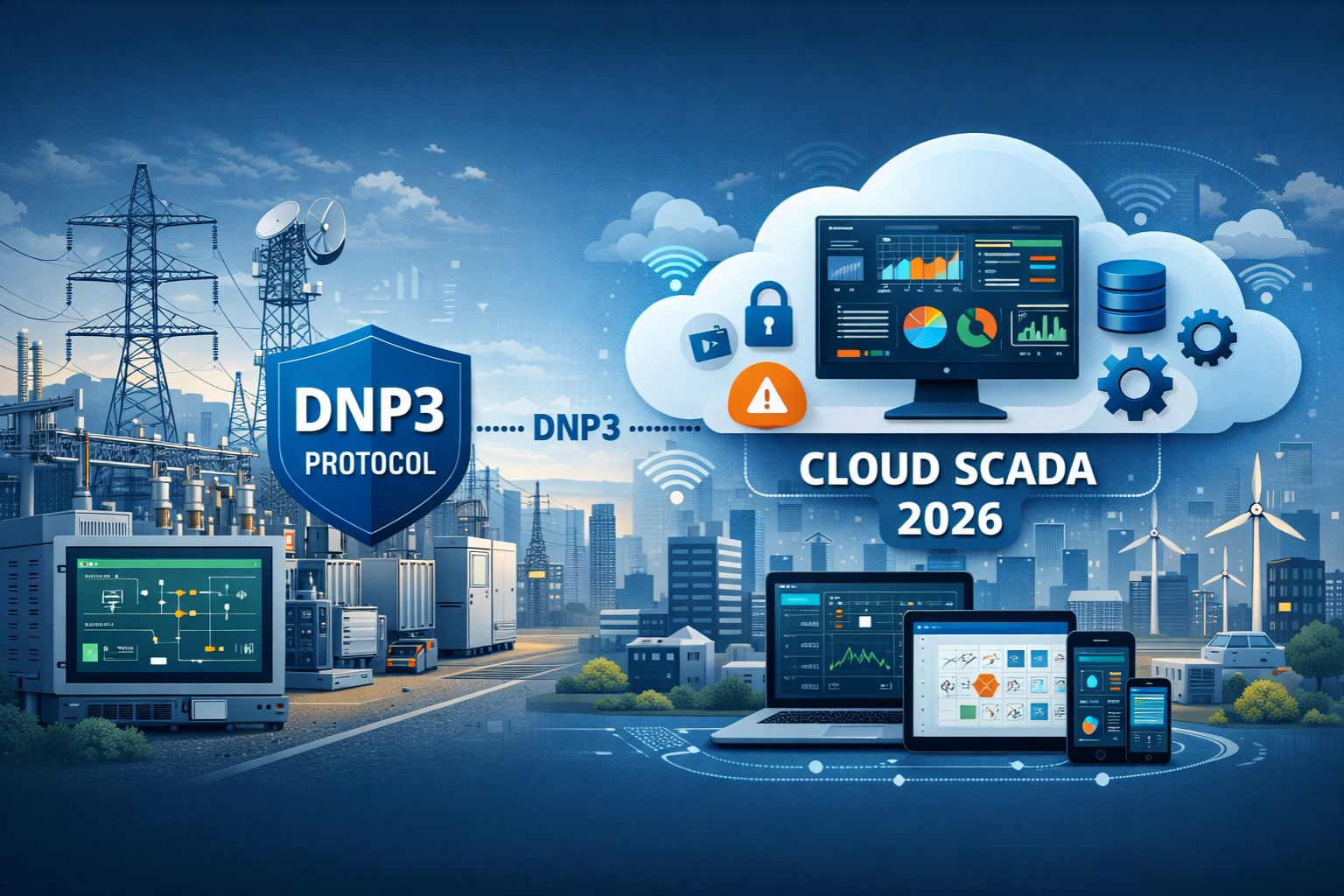
DNP3 Smart Grid Substation Protocol Integration Cloud SCADA 2026
So the push is on to get legacy DNP3 protocols from substation RTUs talking directly to cloud SCADA by 2026. But there's a fundamental mismatch in timing and data semantics that a lot of IT cloud architects just don't see—until the first major grid event happens and nothing triggers. The core problem isn't about getting a connection. It's this assumption that a protocol built for deterministic, serial chatter over leased lines can just be streamed through internet TCP/IP and cloud message brokers, and still keep that millisecond-level state coherence. That coherence is what grid operators actually rely on for safety, and it doesn't survive the trip intact.
What DNP3 Cloud Integration Really Means for Grid Operations
In a real grid, DNP3 isn't just shooting off data points. It's maintaining a continuous, synchronized state table between the master and the outstation. When you route that through a cloud gateway, the normal buffering and packet reordering in standard IoT pipelines can desynchronize those tables completely. An operator might see a breaker status update, which is good, but miss the sequence of events that led to it. And that sequence is the whole story for root cause analysis during a fault. This loss of when things happened—that's the silent failure mode nobody talks about until it's too late.
The Reality of Cloud Latency on Substation Control
Here's the reality under live conditions, especially during a disturbance: DNP3 traffic spikes with unsolicited responses and event buffers. Cloud ingestion services—the ones throttled for cost or set up with generic quality-of-service rules—will introduce unpredictable latency. That can cause the SCADA master to time out on critical Class 1 or Class 2 events. The result isn't just a missing data point. It's worse: the SCADA system might kick off a whole new poll cycle, overwhelming the RTU and creating a cascading communication failure. Exactly when operators need visibility the most.
The Critical Mistake: Treating DNP3 as Simple Telemetry
The most common, and dangerous, assumption is treating DNP3 data objects like simple sensor telemetry for a time-series database. That completely ignores the protocol's object-oriented structure—binary inputs, counters, analog inputs with deadbands—each with its own priority and reporting rules. Flattening all that into a generic cloud data model breaks the inherent data integrity and the reporting class mechanism. After that, it's impossible for the cloud SCADA to accurately replay event sequences or even understand the data quality flags. You've lost the grammar and kept only the words.
Decision Help: When to Tune, Reconfigure, or Redesign the Gateway
So where's the line? It's fairly clear. If your integration is just failing with sporadic timeouts or data gaps, you can probably tune buffer sizes and TCP keep-alives. If you're losing event sequence integrity or facing persistent latency during peak loads, you need to reconfigure the gateway itself with DNP3-aware buffering and priority queuing. But, if your requirement is deterministic, sub-second state synchronization for actual control or protection signaling, then internal fixes won't cut it. That's the point where you need a protocol-aware edge compute layer, something like the Universal Engine Node. Its job is to maintain the DNP3 session locally and stream only context-rich, consolidated state up to the cloud, instead of trying to force a raw protocol tunnel through an environment that wasn't built for it.
FAQ
Question: Can you run DNP3 directly to a cloud SCADA like Ignition or VTScada?
Answer: Technically, yes, you can tunnel it over IP. But you inherit every latency and reliability issue of the public internet. For non-critical monitoring, it might limp along. For any operational decision-making, the lack of deterministic timing makes it a serious risk.
Question: What is the biggest security risk in cloud DNP3 integration?
Answer: Beyond the standard cyber threats, the major risk is actually data integrity. A man-in-the-middle could just delay or reorder DNP3 packets without even altering the data. That would cause the SCADA master to completely misinterpret the grid's state, potentially leading to incorrect—and dangerous—operator actions.
Question: How does NERC CIP compliance affect cloud-based DNP3?
Answer: CIP requirements around asset identification, change management, and network monitoring get exponentially harder when DNP3 sessions traverse cloud provider networks. You often lose all visibility into the exact path and intermediaries, which creates real compliance gaps that are tough to close.
Answer: The tipping point is control. If the cloud SCADA is only for visualization and historical analysis, a robust gateway might be enough. But if you intend for any closed-loop control, automatic switching, or real-time protection signaling, the cloud's non-deterministic nature makes it fundamentally unsuitable. You need a local control loop with the cloud acting as a supervisor. That's a design philosophy that's central to resilient IT/OT integration.